

Reinvent how your institution operates. Stay in control.
Zafin AIOS is an agentic automation platform and control plane for regulated institutions. It orchestrates work across agents, people, systems and institutional knowledge, with human authority, governance and verifiable proof of work built into execution.
Fix a reported bug in the account service.
You · just now
- Designed for regulated institutions
- Proven first inside Zafin
- Built on banking expertise
AI is making tasks
faster. That’s only
the beginning.
Faster tasks don’t automatically mean more delivered work. When handoffs and decisions stay the same, gains can stall between teams. Redesigning the workflow creates an opportunity to do more with the capacity AI makes available.
Redesign the work.
Keep people in charge.
AI-native work changes more than who completes a task. It changes how work is coordinated, where judgment is applied and what your teams can deliver.
Team-coordinated work
People carry the work across handoffs.
Requests move across teams, tools and queues. People transfer context, coordinate dependencies and bring the pieces together for review.
AI-assisted tasks
Tasks get faster. The process stays the same.
AI helps people complete individual steps faster, but handoffs, approvals and queues still follow the original process. Faster tasks do not automatically mean faster completed work.
AI-native workflows
AIOS coordinates execution. People stay in charge.
Agents execute defined work across systems using institutional knowledge and rules. AIOS coordinates the steps, checks outputs and routes exceptions and approvals to people, so teams can deliver complete, reviewable outcomes.
Put expertise where judgment matters.
People set direction, review the work and handle exceptions.
Create capacity to deliver more.
Coordinate execution across agents, people and systems.
Make room for your next priority.
Apply new capacity to modernization, new capabilities and deferred work.
One platform to orchestrate, govern and scale agentic work.
Zafin AIOS brings agents, workflows, institutional knowledge, human approvals and proof of work together on one governed foundation. Start with one use case and extend the same approach as you expand.
Inside the platform
From intent to accepted outcome, on one governed path.
AIOS coordinates work across agents, systems, tools and institutional knowledge to fulfill a defined request. Your institution sets the permissions, review points and acceptance criteria. Governance and proof of work remain part of AIOS-managed execution throughout.
Select any part of the diagram to see what it does and how it works in practice.
Build an AI operating capability
on your institution’s terms.
AIOS provides a governed foundation your teams can configure around institutional knowledge, systems and rules. Choose from supported deployment and model options, define where people remain in authority, and build the internal capability to take on more workflows over time.
Your knowledge & workflows
Build workflows around your institution’s expertise. Keep your knowledge sources, working practices and reviewed outputs connected to the work.
Your infrastructure & models
Run AIOS in supported environments you control, including private cloud or on premises. Choose among supported model providers and open models to match each task, policy and cost.
- Read account history
- Issue refunds up to $500
- Draft customer replies
- Close accounts
Your rules
Define what agents can access, what they may do and when a person must decide. Apply oversight to external agents through the controls their integrations expose.
- Approved by J. Patel09:31
- Refund of $240 drafted09:14
- Policy 4.2 applied09:13
Your evidence
See what was requested, what agents did, which checks ran and who approved the result—with the supporting work kept in context.
Your cost control
See usage in the context of the work. Compare models, reruns and outcomes, then use supported routing, budgets and stop controls to manage execution.
Configure your workflows. Extend what makes you different.
Start with configuration. Extend through supported integrations and tools. Scale proven approaches across additional workflows and use cases.
Configure
Shape workflows, agents, skills, knowledge and policies without changing the platform core.
Extend
Connect proprietary tools and integrations through supported AIOS interfaces.
Scale
Apply established workflow patterns, policies, review points and knowledge to additional use cases.
Put your knowledge to work. Build on what you prove.
Your documents, policies, code and expert judgment hold context that a model alone does not have. Knowledge Fabric connects that institutional context to agentic work.
Over time, reviewed work can become approved knowledge for future workflows. Your teams decide what is trusted and where it applies—helping subsequent work start with more context and less repeated investigation.
Fabric
- Capture KnowledgeDocuments, rules and expertise
The release playbook, repository and service documentation are connected to the workflow.
- Put It to WorkApplied to business tasks
Agents prepare the dependency update using that context and the acceptance criteria.
- Measure ResultsQuality and gaps assessed
Checks run against the criteria. Missing compatibility evidence is flagged.
- Apply Expert JudgmentPeople confirm and correct
An engineer confirms what’s right and adds what was missing: include compatibility evidence.
- Improve the KnowledgeInforms future work
An owner approves the correction as a reference, so the next update to that service includes it from the start.
01Capture KnowledgeThe release playbook, repository and service documentation are connected to the workflow.
02Put It to WorkAgents prepare the dependency update using that context and the acceptance criteria.
03Measure ResultsChecks run against the criteria. Missing compatibility evidence is flagged.
04Apply Expert JudgmentAn engineer confirms what’s right and adds what was missing: include compatibility evidence.
05Improve the KnowledgeAn owner approves the correction as a reference, so the next update to that service includes it from the start.
We changed how we work. Here is what changed.
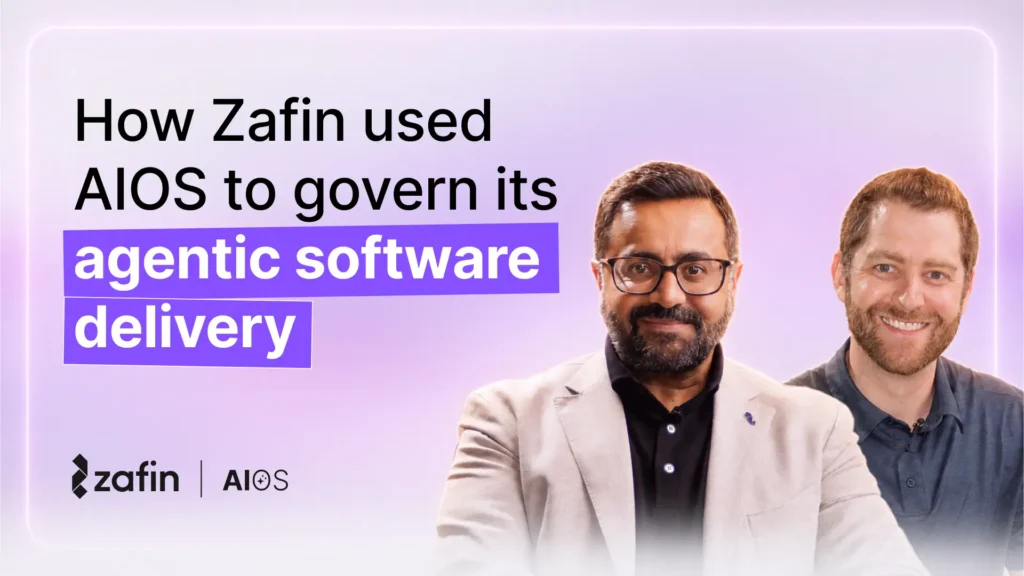
Zafin is Customer Zero for AIOS. We used it to change how our teams deliver software and to build a revenue-operations application around our own needs.
More resolved work. Lower cost per resolution.
Zafin applied AIOS to Deal Manager enhancements and defects within the Banking Platform. Agents help clarify, reproduce and resolve requests, with review context and evidence attached to the work.
- Before
Engineers and testers reconstructed requests and coordinated work across queues.
- With AIOS
A shared work path connects context, agent execution, checks and human review.
- What changed
Human effort concentrates more on judgment and acceptance; delivery capacity is measured at the resolved-work level.
more enhancement requests and defects resolved without proportional capacity growth
reduction in cost per resolution
of AIOS-routed work instrumented with status, duration, cost visibility and Proof of Work
Zafin-reported results for initial Customer Zero use cases and in-scope workflows. Results vary by scope and environment.
One operating view for sales, forecasting and board reporting.
Zafin used AIOS to connect sales, forecasting and board reporting information in a purpose-built operating view, with defined access, privacy and review requirements.
- Before
Board reporting depended on manual consolidation across disconnected tools and artifacts.
- Built with AIOS
A purpose-built operating view organized around Zafin’s own workflow and reporting needs.
- What this demonstrates
Creating an operating capability around Zafin’s own workflow and reporting needs, with defined access, privacy and review controls.
reported reduction in effort for board reporting
reported reduction in platform cost for the existing revenue-operations workflow
of in-scope customer-data workflows follow defined role, access, privacy and audit guardrails
Zafin-reported results for this internal workflow, not a general productivity benchmark.
Start with one workflow.
Expand from there.
Choose a workflow with clear ownership and measurable outcomes. Use that experience to establish a repeatable approach, then apply it to your next priority.
$ aios run bug-fix --scope account-service
Reproduced: available() ignores pending holds
- return a.bal - a.hold
+ return a.bal - a.holds()
Running regression test… 42/42 passed
Redesign how your delivery teams work.
Coordinate enhancement and defect work from investigation through testing. Agents take on defined tasks, while engineers review changes, check results and decide what moves forward.
| A | B | C | |
|---|---|---|---|
| 1 | ACCT_NM | SEG | ARR_USD |
| 2 | NORTHWIND BK | COM | 1200000 |
| 3 | HARBOR CU | RET | 840000 |
| 4 | ALDER CAP | COM | 310000 |
Brownfield modernization
Understand and modernize the systems you already own.
Use existing code, documentation and institutional context to analyze legacy systems, prepare modernization work and review proposed changes before they move forward.
Governed regulated work
Turn evidence-heavy processes into governed workflows.
Bring policy research, evidence collection and case preparation into a defined workflow. Route exceptions to the right reviewers and maintain a record of checks, decisions and approvals.
Bring the work you want to change.
Discuss your priorities with the AIOS team, explore where the platform fits and identify a practical next step.
The thinking.
The practical questions.
Explore the operating model, the platform choices and the controls behind agentic work.
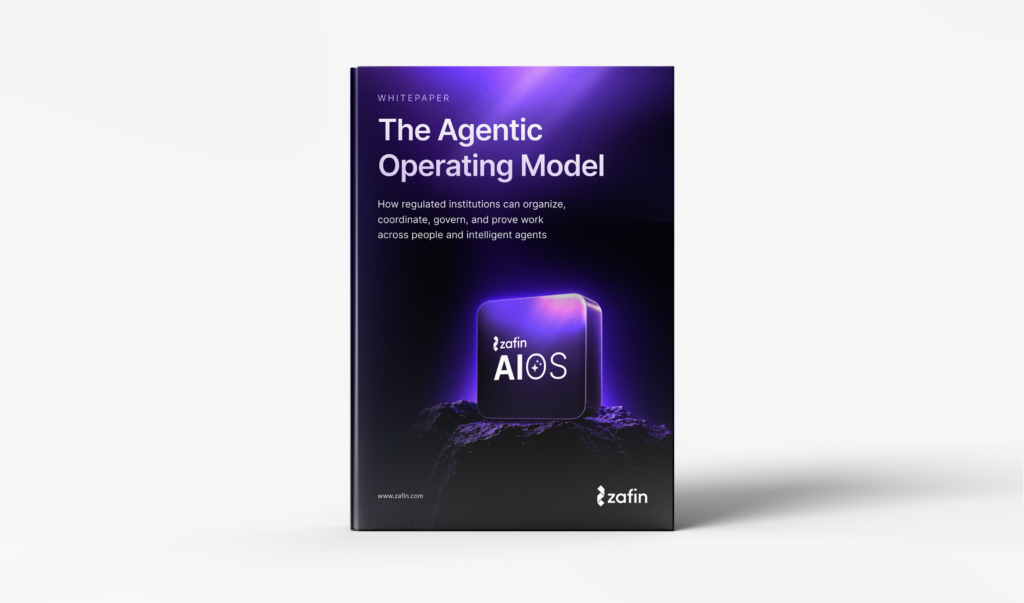
White paper
The Agentic Operating Model
The organizational shift behind a different way of working.
Evaluation guide
AI Agent Orchestration Platforms for Banks: A Practical Evaluation Guide
Questions to ask about the foundation for agentic work.
Technical perspective
From Policy Document to Runtime Enforcement
How authority and evidence connect to agent execution.
Your questions, answered.
What is Zafin AIOS?
Zafin AIOS is an agentic automation platform and control plane for regulated institutions. It orchestrates work across agents, people, systems and institutional knowledge, with human authority, governance and proof of work built into execution.
What changes in an AI-native operating model?
Teams design work around intended outcomes, shared context and clear decision rights. Agents execute defined work alongside systems and people. Leaders then decide how to use the resulting capacity and how roles and processes should evolve. A platform enables this change; those decisions stay with you.
How is this different from an agent, model or copilot?
An AI model provides intelligence; an agent performs tasks; a copilot helps a person work. AIOS coordinates these capabilities across workflows and systems, adding authority, controls, cost visibility and proof of work to support governed execution.
Can we work with the models and systems we already use?
Yes. AIOS connects to your existing systems, repositories and data through supported integrations, and works with supported model providers and open models in approved environments.
What about agents built outside AIOS?
AIOS can work with supported external agents through available integrations. Visibility and controls vary depending on the connection and the capabilities exposed by the external platform. AIOS does not require replacing every external agent runtime, but it does not provide identical control over every third-party agent.
Can we configure and extend AIOS?
Yes. Teams can configure workflows, agents, skills, knowledge sources and policies for their use cases, and connect proprietary tools through supported interfaces. Established workflow patterns and governance practices can then be applied to additional use cases as adoption expands.
What can our institution control?
Your institution defines workflow rules, access permissions, approval points and the knowledge used for AIOS-managed work. You can select from supported models and deployment environments, and review agent activity, checks, decisions and outcomes through proof of work records. Available options depend on the deployment and integrations.
Does knowledge reuse mean human review goes away?
No. Institutional context and reviewed experience can inform subsequent work, but you determine what is approved for reuse and where human review remains mandatory. Greater autonomy should reflect evidence and policy, not simply the number of runs.
How should we start?
Choose a workflow with a defined owner, clear scope and measurable outcomes. Discuss its systems, knowledge and approval needs with the AIOS team, then identify a practical starting point and a way to evaluate the change.
Still have a question? Talk to the AIOS team.