






TL; DR:
Banks moving agentic AI from pilots to production need more than capable agents. They need a way to govern how agentic work is routed, executed, reviewed, evidenced and paid for.
- Evaluate AI agent orchestration platforms based on how they handle context, routing, interoperability, authority and human intervention, evidence, and cost and performance.
- Zafin AIOS provides governed orchestration and control for agentic work in regulated environments, connecting approved agents, models, knowledge, tools and people.
- Zafin’s strongest production proof today comes from Customer Zero, including agentic software delivery, where Zafin has reported an 80% reduction in cost per resolution.
According to MIT Technology Review Insights, 52% of banks have piloted agentic AI, but only 16% have fully deployed it into production.
Closing the gap between pilot and production requires more than capable AI agents. Banks need a way to orchestrate agentic work while governing how agents access systems, exercise authority, incur costs and escalate decisions.
Getting one agent to complete a task is relatively easy. The challenge begins when hundreds of agents can change records, call tools, approve exceptions, or delegate work to other agents. At that point, banks need to coordinate agents, access, context, models, costs, and human oversight while maintaining clear evidence of how work was executed.
That is where an AI agent orchestration platform becomes critical: coordinating how agents work while providing the controls banks need to govern execution at scale. But not all platforms provide the same depth of orchestration and control.
This article explains how banking technology leaders can evaluate the capabilities that matter when moving agentic AI into production.
What Really Is an AI Agent Orchestration Platform?
An AI agent orchestration platform coordinates how agents, models, tools, data, enterprise systems and people work together to complete a workflow.
For banks, orchestration cannot simply mean routing tasks between agents. It also needs to operate within defined controls for identity, authority, policy, human intervention, cost and evidence.
This distinction matters because the market increasingly includes agent builders, model platforms, orchestration frameworks, observability products and control layers that solve different parts of the problem.
Forrester offers a useful distinction through three planes: build, orchestrate, and control.
Build is where agents are created. It covers models, frameworks, tools, and infrastructure. It answers: how does the agent think and act?
Orchestrate is where agents are embedded into workflows. It handles routing, sequencing, and coordination across systems. It answers: how does the agent fit into operations?
Control provides independent oversight across both. It handles visibility, policies, permissions, and runtime control. It answers: who are you, what are you allowed to do, and what did you do?
Some platforms span multiple functions. The important question for a bank is therefore not what a vendor calls itself, but which responsibilities it actually performs.
So, what should a good orchestration platform solve for?
What Should an AI Agent Orchestration Platform Do for a Bank?
As agentic AI scales, AI sprawl can quickly become operating-model sprawl, with governance, cost, evidence and authority struggling to keep pace. Technology leaders therefore need an orchestration platform that can deliver four things:
Govern execution: Define what agents are authorized to access, decide, initiate or change, and enforce those boundaries during execution.
Orchestrate work: Route work across the appropriate agents, models, tools, systems and human reviewers based on context, complexity, risk, cost and required quality.
Control cost and performance: Make the cost, latency, quality and performance of agentic work visible and attributable at the workflow and task level.
Maintain evidence: Preserve a traceable record of how work was executed, including agent actions, model and tool use, human decisions, approvals and outcomes.
Once those jobs are clear, the next question is whether a platform can actually deliver them in practice.
How to Evaluate AI Agent Orchestration Platforms for Banking Workflows
These are the six practical questions banks should ask, rather than the feature list a vendor will lead with:
- Context and grounding – Does each agent receive the information it needs, and only what it needs?
- Routing and orchestration – Can the platform determine which agent, model, tool or human should handle each part of the work?
- Interoperability – Can it work across the bank’s existing systems and approved technology ecosystem?
- Authority and human intervention – Can the bank control what an agent is permitted to do and when a person must intervene?
- Evidence and governance – Can the institution reconstruct what happened and demonstrate that policies were followed?
- Cost and performance – Can the bank understand and optimize the economics and performance of agentic work?
Context and Task Decomposition
Test whether the platform can break complex work into bounded subtasks and create new tasks as the work evolves. For example, a customer dispute may require multiple bounded tasks: retrieving relevant account and transaction information, classifying the dispute, applying the appropriate policy, preparing a recommended action and routing higher-risk or exceptional cases to an authorized employee.
Moreover, each agent should receive only the context it needs for its role, while the platform preserves dependencies, decides what can run in parallel, and avoids long agent chains that increase token usage, latency, and error risk.
The same principle applies to software delivery. An enhancement or defect may trigger implementation, testing, review and remediation tasks as the work progresses.
Intent-based Routing
Test whether the platform routes each task in a workflow to the right model, agent, tool, and execution environment based on complexity, data sensitivity, required quality, and cost. No single model is best across quality, latency, cost, and domain, so routing should happen at the subtask level rather than locking an entire workflow to one model.
For example, a routine classification or summarization task may be routed to a lower-cost model, while a complex reasoning task may be routed to a more capable model that justifies the additional cost.
Additionally, routing should include the ability not to automate. If confidence is insufficient, required context is missing, or an action exceeds delegated authority; the platform should be able to stop execution or route the work to an authorized person.
Interoperability
Test whether the platform can orchestrate agentic work across the systems the bank already relies on, including CRM platforms, databases, work-management systems, internal APIs, document stores, and code repositories, while allowing the bank to preserve its existing technology environment. The platform should also operate across approved agents, models, and hyperscalers so the bank is not locked into a single vendor stack.
The goal should be to reduce dependency on any one model or agent ecosystem rather than introduce a new form of lock-in.
Authority and Human Oversight
Human oversight is not simply about inserting approval steps into every workflow. The more important question is what an agent is authorized to do, and when human authority is required.
Test whether the platform can define what an agent may access, recommend, initiate or change; establish thresholds that require human authorization; pass the necessary context to the reviewer; and continue execution after the decision without unnecessarily restarting the workflow.
Human intervention should be concentrated where judgment, accountability or delegated authority requires it rather than becoming a manual checkpoint on every agent action. Reviewer feedback, including approvals, rejections, ratings or requests to redo work, should also be captured for evaluation and subsequent improvement.
Evidence and Runtime Governance
Enterprise AI can create governance debt when autonomous decisions cannot be explained, evidenced, or reconstructed later. Test whether the platform can enforce permissions, authority limits, approval gates, policy rules, and kill switches at a granular level, down to a specific agent, data source, tool, or action.
Then test the evidence it produces. Can the bank reconstruct the path from request to outcome, including what agents did, which models and tools were used, where humans intervened, what was approved and what the final outcome was?
For regulated institutions, logging activity is not the same as producing defensible evidence of how work was executed.
Cost and Performance
Agentic workflows introduce a new unit of enterprise cost: the cost of completing work through combinations of agents, models, tools and compute.
Test whether the platform can attribute cost and performance to individual tasks and workflows, compare different execution paths, and route work based on the required balance of quality, latency and cost.
Cost governance should be part of orchestration, not simply a dashboard showing spend after it has occurred.
With those criteria in mind, here’s where Zafin AIOS fits.
When Should Banks Consider Zafin AIOS?
Zafin AIOS is the end-to-end AI agent orchestration platform and control plane that lets regulated institutions deploy and govern approved agents, models, knowledge sources, and workflows across enterprise environments.
It keeps humans in charge of intent, key decisions, and exceptions while routing work to the right agents, models, and tools based on risk, cost, and complexity.
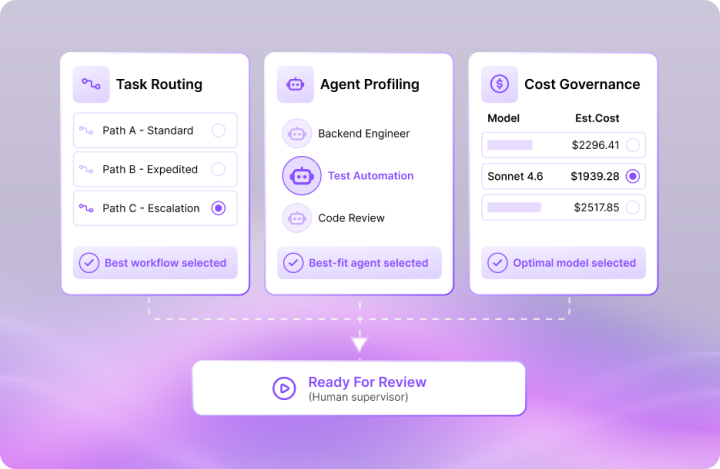
Zafin AIOS orchestration layer managing routing, agent selection, model governance, and human review
Best Suited for
Banks moving complex agentic workflows toward production where governance, authority, evidence, interoperability, cost or operating ownership remain unresolved.
Organizations evaluating agentic software delivery are a particularly strong fit today because this is where Zafin has its deepest Customer Zero evidence.
Key Features and Benefits
Gartner predicts over 40% of agentic AI projects will be cancelled by 2027, citing escalating costs, unclear business value, and inadequate risk controls as the reasons. AIOS closes exactly those three gaps.
Governed execution
Define agent roles, permissions, review gates, escalation paths and exceptions so agentic work operates within established boundaries.
Orchestration across agents, models and humans
Coordinate work across specialized agents, models, tools and human reviewers while routing each task according to its requirements.
Proof of work
Capture the execution path from request to accepted outcome, including agent activity, human intervention, approvals, tests, cost and outcomes.
Cost and performance governance
Track the economics and performance of agentic work and use routing decisions to balance quality, latency and cost.
Approach to Orchestration
Multi-agent chains get expensive and fragile fast: more context to carry, more places to fail, and more decisions to account for. Orchestration is what keeps that chain from collapsing under its own weight. Here’s how Zafin AIOS creates a symphony, not a scramble.
Governed, not open-ended, execution: Agents work within a bounded set of possible next steps rather than deciding freely. This means the platform stays predictable at scale; more agent activity doesn’t translate into unpredictable behaviour.
Context stays scoped, not accumulated: Each step passes only the structured inputs and outputs it needs forward, rather than the full history. This avoids the runaway cost and accuracy loss that comes from context bloating as a chain of work gets longer.
Failure doesn’t mean starting over: When a step fails, AIOS retries using a stored session instead of restarting the task from scratch, since sessions persist across harnesses. Work in progress isn’t lost to a single point of failure.
Review outcomes actively shape future work: Tasks carry a clear outcome (approved, rejected by a reviewer, or failed by the agent), and that outcome feeds back into how later work gets redirected, redone, or reused. Human judgment isn’t a one-time gate; it improves the system over time.
Fleet-wide visibility across concurrent work: Zafin AIOS tracks multiple agents working on different tasks at the same time, giving a real-time view of what the whole fleet is doing, not just one workflow in isolation.
The workflow goal stays fixed as complexity grows: Adding more steps to a workflow may add latency but doesn’t change what the workflow is trying to accomplish. The definition of “done” doesn’t drift as the work gets more complex.
Case Studies
Zafin is a Customer Zero for AIOS. By applying it first across its own product delivery, revenue operations, and governed workflows, Zafin has realized measurable gains across two areas.
Zafin replaced off-the-shelf enterprise CRM and reporting tools with a purpose-built operating view built on AIOS for sales, forecasting, and board reporting. This brought:
- 100% of in-scope customer data workflows follow defined roles, access, privacy, and audit guardrails.
- 90% reduction in effort for board reporting.
- 80% reduction in platform cost for the existing revenue operations workflow.
Zafin also uses AIOS to manage enhancement requests and defect resolution for the Zafin Banking Platform, bringing more visibility and control to software delivery. This brought:
- 100% of AIOS-routed work has status, duration, cost visibility, and proof of work.
- 80% reduction in cost per resolution.
- 75% more enhancement requests and defects resolved without proportional growth in engineering capacity.
See how Zafin AIOS orchestrates agentic work from intent to governed outcome:
Next Steps
If your bank is ready to move from AI experimentation to governed agentic work, request a briefing.
Frequently asked questions
An AI agent orchestration platform coordinates how agents, models, tools, data, enterprise systems and people work together to complete a workflow. For regulated industries, orchestration also needs to happen within defined controls for identity, authority, policy, human intervention, cost and evidence.
An agent builder is primarily used to create and configure individual AI agents, including their instructions, capabilities, tools, and access to models or data. An orchestration platform operates at the workflow level, coordinating multiple agents, models, tools, and systems to complete a broader process.
Banks should evaluate an AI agent orchestration platform across six areas:
- Context and grounding: Can each agent access the information it needs, while limiting access to information that is not required?
- Routing and orchestration: Can the platform determine which agent, model, tool, or human should handle each part of the work?
- Interoperability: Can it work across the bank’s existing systems, applications, data sources, and approved technology ecosystem?
- Authority and human intervention: Can the bank define what an agent is permitted to do and determine when human intervention is required?
- Evidence and governance: Can the institution reconstruct what happened and demonstrate that policies, controls, and approvals were followed?
- Cost and performance: Can the bank measure, understand, and optimize the cost and performance of agentic work?
Control should be defined at the level of what an agent can access, recommend, initiate, or change, with clear thresholds for when human authorization is required. Rather than inserting an approval step into every action, the platform should concentrate human review where judgment or accountability genuinely requires it, then pass full context to the reviewer and resume execution once a decision is made, without restarting the workflow.
Cost control starts with routing: sending simple or low-risk tasks to lower-cost models and reserving more capable, expensive models for tasks that justify them, rather than locking an entire workflow to one model. It also requires attributing cost to individual tasks and workflows, not just tracking total spend after the fact, so a bank can compare execution paths and adjust the balance of quality, latency, and cost before costs accumulate.
Agentic SDLC workflows can use different orchestration patterns depending on the work involved. The MAS-Orchestra framework reinforces why that choice matters: multi-agent systems do not perform better by default, and their gains depend on how the task is structured and coordinated.
- Sequential Pipelines: Agents work through dependent stages in order, such as implementation, testing, review, and remediation.
- Router / Handoff: A router directs a work item to the appropriate specialist agent or model based on what the task requires.
- Fan-Out / Fan-In: Independent engineering tasks run across multiple agents in parallel, with their outputs later consolidated.
- Hierarchical Orchestration: Complex work is decomposed and coordinated across several specialist agents or teams, with a higher-level coordinator managing the overall task.
- Human-in-the-Loop: Humans intervene where review, approval, exception handling, or higher-risk decisions require judgment.
For regulated software delivery, the key question is not which orchestration pattern you choose, but whether every agentic step remains governed, reviewable, and traceable from request through testing, approval, and release.
Pilots can prove that agents write code or resolve individual tasks. Scaling is harder because engineering teams also need consistent delegation, verification, permissions, cost controls, and evidence across the SDLC. McKinsey finds that teams seeing stronger gains build shared orchestration and evaluation capabilities instead of letting each team improvise its own agentic workflow, whether for SDLC or any other agentic workflows.