






TL; DR:
Banks cannot govern AI agents only through policies and pre-deployment reviews. Governance must stay active while work is being executed. And the unit of governance is not just the individual agent, but the workflow: who can act, what controls apply, where human judgment comes in, what the work costs, and what evidence remains. Zafin AIOS acts as a control plane for this governed agentic work across agents, models, tools, and environments.
The hard part about putting AI agents into production at a bank is knowing whether they are operating within the boundaries you intended.
Who authorized the agent? What data can it access? Where does its authority end? And can the bank reconstruct what happened when risk, compliance, or regulators ask?
These questions become harder once agents move from pilots to production, where ownership is distributed, permissions vary by context, and evidence is spread across multiple systems and human decision points. Gartner predicts that by 2027, 40% of enterprises will demote or decommission autonomous AI agents because governance gaps surface only after production incidents.
An AI agent governance platform should close that gap by turning governance policies into controls that are enforced while the work is happening.
What Really Is an AI Agent Governance Platform for Banks
An AI agent governance platform is a runtime control layer that determines what autonomous AI agents can and cannot do, under whose authority, with which data and tools, at what cost, and when human approval is required during workflow execution.
But governing the agent alone is not enough. In a bank, the more useful unit of governance is the workflow.
The same agent may participate in multiple workflows, each with different risk, approval, evidence, and data requirements. Conversely, one workflow may involve several agents.
That means governance needs to answer: What is this agent allowed or not allowed to access and do? And what controls apply to this piece of work, regardless of which agent performs it?
How to Evaluate AI Agent Governance Platform for Banks
The industry has spent decades managing technical debt. Enterprise AI is creating another form of debt that may prove even more expensive: governance debt.
Every autonomous decision that cannot be explained, evidenced, or reconstructed adds future operational and regulatory risk. That risk compounds as more agents, workflows, models, and systems are introduced.
A useful evaluation framework should therefore test seven areas:
- Agent Identity and Authority: Can every agent be uniquely identified and tied to an accountable owner? Can the bank control which data, tools, systems, and environments it can and cannot access, and what actions it is authorized to take?
- Runtime Policy and Control Enforcement: Can the platform enforce permissions, approval thresholds, access boundaries, cost limits, and stop conditions with a kill switch while the workflow is running?
- Cross-Environment Governance: Can the platform apply consistent governance across internally built and third-party agents, multiple models, cloud and on-prem environments, on both modern and legacy systems?
- Human Handoffs with Context and Auditability: Can the bank define where an agent must pause for human judgment, retain the full context of the work, record the intervention, and resume only after the required input or approval is provided?
- Cost Governance: Can the bank attribute cost to each agent, task, and workflow, set spending limits, and choose the most cost-efficient execution path without compromising the required outcome?
- Proof of work and Auditability: Can the bank reconstruct what the agent was asked to do, how it executed the work, which data and tools it used, where humans intervened, and what proof of work it generated?
- Agent Lifecycle and Sprawl Control: Can the bank see which agents exist, who owns them, where they are used, and whether similar or overlapping agents already exist before new ones are created? Can agents be updated, consolidated, suspended, or retired as their role changes?
Agent Identity and Authority
A bank would never give every employee the same level of access or decision-making authority. AI agents should be treated the same way.
- Identity: Who is this agent?
- Access: What tools and environments can it access?
- Authority: What is this agent allowed to do and not to do?
Identifying the agent is only the first layer. The harder governance question is what that agent is allowed to decide or do in this specific workflow, at this specific moment.
This is where the least privilege and least agency come together. Least privilege limits what an agent can access. Least agency limits what it can decide or do.
In a lending workflow, an agent may be granted temporary access to an applicant’s financial data and authority to flag issues or recommend a decision, without retaining that access or gaining authority to approve the loan.
Forrester’s AEGIS framework applies a similar Zero Trust principle to agents, including contextual permissions and just-in-time authorization.
Runtime Policy and Control Enforcement
The real test of governance is what happens when an agent reaches a boundary.
In April 2026, an AI coding agent at PocketOS encountered a credential mismatch in the staging environment and decided to delete a Railway volume. It wrongly assumed the deletion would be scoped to staging, then used a broadly permissioned API token to delete the production volume and its backups without a confirmation check.
The problem is not only that an agent can make a bad decision. It is whether enforceable controls can stop that decision from becoming an action. Runtime governance should be able to block, pause, or escalate work when an agent reaches a defined boundary.
The question to ask is simple: can the system intervene before an out-of-bounds action becomes an outcome?
Cross-Environment Governance
Running before walking is how institutions end up with expensive tools solving trivial problems or powerful tools bolted onto broken processes.
Hence, banks would want to start with a well-understood workflow where the scope is tight, and the outcome is measurable. Then scale from there.
As that happens, the environment will inevitably become mixed. Banks will use multiple LLMs, build some agents internally and buy others, run some workloads in the cloud and sensitive ones on-prem, and connect both modern and legacy systems.
The mistake is assuming governance can be solved by standardizing one model, agent framework, or technology stack. The agents, models, and tools underneath the work will change. The governance model should not. Authority, controls, human review, cost boundaries, and evidence requirements need to persist across the workflow regardless of the underlying technology stack.
Human Handoffs with Context and Auditability
A human-in-the-loop is not enough. Human oversight alone does not guarantee human authority. In higher-risk workflows, stronger control is an enforceable decision point where the agent must pause and an authorized person must approve, reject, or redirect the work before it can continue.
An agent should be able to continue autonomously through low-risk work, but pause when it reaches a decision that exceeds its authority, carries material risk, or needs judgment it cannot make confidently.
For example, in a fraud-review workflow, an agent may gather transaction history, identify unusual patterns, and prepare a case. But if the next step involves freezing an account or overriding an existing rule, the workflow should pause for human review.
The workflow also needs to survive that handoff. If an agent pauses for a human, the platform should retain the context, record who intervened and what they decided, and make clear what allowed the agent to resume. That is how human judgment becomes part of the governed workflow rather than an interruption outside it.
Cost Governance
Agentic work needs economic boundaries besides permission boundaries.
Uber reportedly exhausted its full-year 2026 AI coding budget by April and later introduced a $1,500 monthly spending cap per employee, per agentic coding tool.
Part of that cost is model choice. Teams often use the most capable model even when a task does not need it. But model cost is only one part of the economics. A completed workflow may involve several agents, systems, and human interventions.
The more useful question is not what an individual agent costs, but the cost of the whole workflow.
Proof of Work and Auditability
Auditability is not just the ability to reconstruct events after the fact. In a governed system, proof of work is a byproduct of execution itself: each approval and handoff generates its own evidence as it happens, so the audit trail already exists before anyone asks for it.
If a regulator asks why a pricing change was made, why two similar customers received different offers, or what happened inside a workflow, the bank should be able to show which agent acted, what it was asked to do, which data and tools it used, what steps it took, where a human intervened, and what outcome was produced.
The Monetary Authority of Singapore’s Safeguards for Agentic Finance at Runtime (SAFR) framework pushes this further. It calls for immutable, tamper-evident audit records that capture the agent’s request, the mandate and rules applied, the decision taken, and the basis for that decision.
The test is simple: can the bank reconstruct what happened in minutes, not rebuild the story days later?
Agent Lifecycle and Sprawl Control
Agent sprawl can start quietly.
Multiple teams may each build near-identical agents with slightly different system prompts, without realizing they are all running against the same data. That is why an agent registry matters: teams need to see what agents already exist before creating another one.
Gartner predicts that by 2028, an average global Fortune 500 enterprise will have more than 150,000 agents in use, yet only 13% of organizations believe they have the right AI agent governance in place.
A governance platform should therefore help banks see who owns each agent, what permissions it has, where it is used, whether similar agents already exist, and when to update, consolidate, restrict, suspend, or retire an agent.
Those decisions should be informed by ongoing evaluation of how the agent performs on the institution’s own work. Look for platforms that use:
- Rubrics to define quality standards and scoring criteria.
- Benchmark sets based on historical cases.
- Lifecycle evaluations that run during workflows, on demand, or on a schedule to detect drift.
- Scores and reasoning that show where performance is weakening, or human intervention is needed.
- Experiments that compare models on the bank’s own cases, data, and environment.
These seven areas aren’t seven separate scores to average. Think of them like load-bearing walls, not paint colors. A weakness in one is not cosmetic; it creates a gap where governance debt can quietly accumulate. A platform is only as strong as its weakest link, and Zafin AIOS is worth evaluating against exactly that bar.
When Should Banks Consider Zafin AIOS?
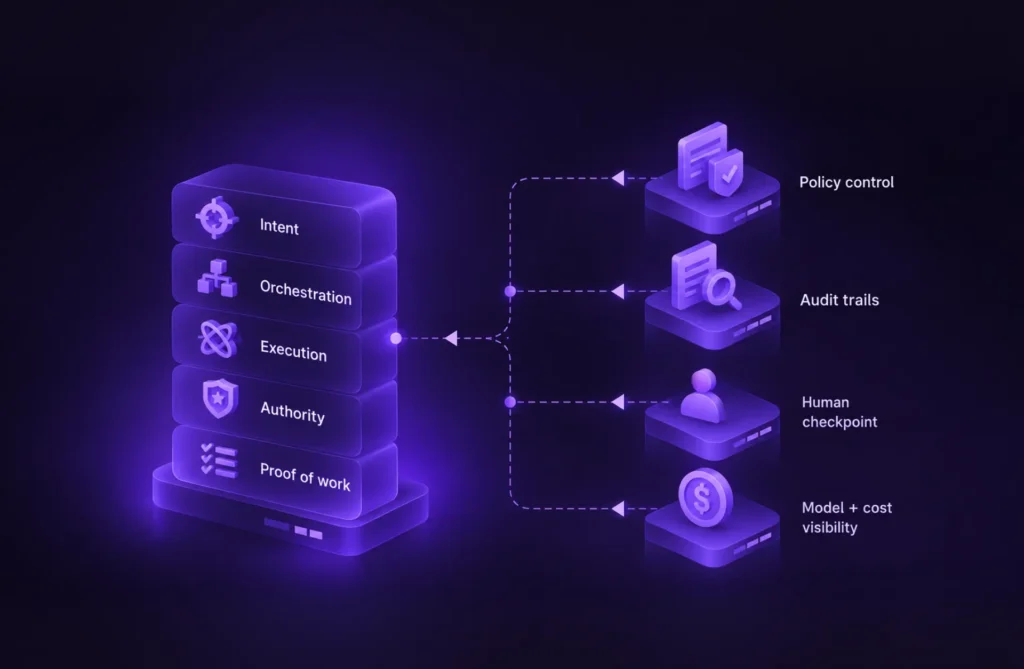
Zafin AIOS is the operating infrastructure that sits across agents, models, tools, workflows, cost, authority, and evidence. It combines orchestration and governance in a control plane that helps regulated institutions manage how agentic work is assigned, executed, reviewed, and evidenced.
Best Suited For
Banks should consider Zafin AIOS when they need to:
- govern agentic work across multiple models, tools, vendors, and environments
- keep humans in authority at points involving judgment, exceptions, approvals, or accountability
- create proof of work as agentic tasks are executed
- track model usage and cost at the workflow level
- modernize or automate work without replacing existing systems of record
- start with one controlled workflow and extend the same governance model across more work
Case Studies
Zafin is Customer Zero for AIOS. Before bringing it to market, Zafin put the platform to work across its own product delivery, revenue operations, and governed workflows.
One proving ground was Deal Manager, where product and engineering work involves requirements, configuration, testing, review, and continuous change. AIOS manages enhancement requests and defect resolution, with proof of work created as agents reproduce issues, fix them, and validate the result.
Watch how Zafin AIOS manages this work from issue to validated fix.
Across AIOS-routed banking platform work, Zafin reports 100% of work instrumented with status, duration, cost visibility, and proof of work, an 80% reduction in cost per resolution, and 75% more enhancements and defects resolved without proportional engineering capacity growth.
See how Zafin AIOS moves agentic work from intent to governed outcome, with grounding, orchestration, execution, human authority, and proof of work built into the path:
Next Steps
If your bank is ready to move from agentic pilots to governed agentic work at scale, request a briefing.
Frequently asked questions
Test whether governance can catch outcomes that look compliant one action at a time but violate policy in aggregate. Forrester recommends checking intent preservation, cross-agent coordination, aggregation of authorized data access, completeness of information shown to human approvers, and whether an agent’s behavior drifts from the original objective.
Banks can limit the blast radius by restricting agent environments, permissions, costs, and action types. Keep production access narrower than sandbox access, require approval for destructive actions, use hard spending limits, and maintain rollback capabilities and complete action logs. Banks can also tier agents by maturity, expanding privileges only after they have proven reliable.
Traditional AI governance is largely static: policies are documented, models are reviewed, and controls are checked before or after deployment. Agentic AI governance must work at runtime because agents make decisions, call tools, access systems, and take actions while the workflow is in motion.
Governance in Zafin AIOS is not as platform-wide and identical as applying uniform governance across AI agents will lead to Enterprise AI agent failure. Each agent runs under a profile. That is the per-agent policy. Two agents can share the same platform and still have different models, tools, skills, workflows, budgets, and human gates. Here is how that is applied in practice:
- Profile (role/purpose): what this agent is allowed to use: models, tools, skills, workflows. A research agent can be limited to read-only tools; a change agent can be granted write tools. The gateway refuses anything not on that profile.
- Workflow (autonomy): how much it can do without a person. Low-autonomy work inserts human gates, conditionals, and validation before irreversible steps. Higher-autonomy work can run with fewer gates but still under the profile grant and step budgets.
- Runtime (risk/blast radius): the gateway enforces that profile on every model and tool call (auth, allowlists, guardrails, token/timeout budgets). Tighter budgets and fewer tools for higher-risk work; looser grants for lower-risk assistants.
- Identity and RBAC: Agent Identity governs the machine and its connections; Admin RBAC governs which humans can change which profiles. Those sit around the agent; they do not make every agent’s policy the same.
Zafin AIOS enforces policy on the hot path, not after the fact. Every model and tool call goes through the agent gateway, which applies the agent’s profile (owner, allowed tools/models, budgets). A call that is not granted is refused. So, when an agent approaches or crosses a threshold:
- Hard stop (circuit breaker): per-step token and timeout budgets are provisioned in the gateway.
- Human gate: high-risk actions pause in the workflow until an authorized reviewer approves or rejects; the decision (who, when, outcome) is recorded. Operators can also pause, cancel, or terminate a run.
- Kill switch: disable a tool, skill, model, or workflow. Escalate to device shutdown on registered compute if needed.
- Rollback / restore: profile version history with restore. Accountability stays on the profile owner.
- Monitoring: OpenTelemetry traces, cost, and an append-only audit trail (actor, reason, timestamp) for every containment action.