






Artificial intelligence is beginning to change something far more fundamental than productivity: how work gets done.
For decades, enterprise operating models have been built around a simple assumption: people perform the work, while software supports them. Processes, governance, approvals, and organizational structures all evolved around that model.
Agentic AI changes that assumption.
For the first time, work is being executed by people and intelligent agents together. AI is no longer simply helping people complete tasks. It is beginning to research, analyze, design, build, test, document, and coordinate work alongside them. That creates significant opportunities for speed and scale, but it also requires a fundamentally different operating model.
How do you govern work when it is no longer performed exclusively by people?
That question is becoming increasingly urgent. Gartner’s 2026 CIO and Technology Executive Survey found that 58% of banking CIOs have already deployed AI agents or expect to deploy them within the next 12 months. The technology is advancing faster than organizations can redesign how work is coordinated, governed, and proven.
The question is no longer whether organizations will adopt AI. It is how they will organize work once AI becomes an active participant in it.We refer to this emerging approach as the Agentic Operating Model: a way of organizing enterprise work when people and intelligent agents perform work together under shared governance.
This shift will separate organizations that translate AI into enterprise advantage from those that simply accumulate more tools.
Why the operating model becomes the constraint
The shift sounds abstract until you see it in a familiar enterprise workflow. Consider a software modernization initiative.
A business team identifies an opportunity to modernize an application. Requirements are gathered, the solution is designed and built, security and QA review it, operations prepare for deployment, and evidence is collected for governance and audit.
The process is deliberate and structured, but it depends on specialized teams handing work to one another. Every stage introduces another review, another queue, another approval, and another opportunity for delay. The operating model assumes that people perform the work while systems support them.
Now imagine that same initiative starting now.
Requirements are interpreted with the help of AI. Existing code is analyzed automatically. Architecture options are generated in minutes. Specialized agents build components, generate tests, identify vulnerabilities, draft documentation, and recommend deployment plans. Human experts remain involved throughout the process, but their role increasingly shifts toward judgment, approvals, exception handling, and governance.
At first glance, this looks like a faster software delivery process. It isn’t. The work is now being performed by a different combination of participants. Enterprise work is no longer executed solely by people. It is carried out by a dynamic combination of people, AI agents, models, enterprise knowledge, systems, policies, and approval authorities, each contributing different capabilities at different stages of the workflow.
That changes the design problem entirely. Success is no longer defined by managing a sequence of human handoffs. It depends on coordinating the right participants, applying the right authority at the right moments, and maintaining accountability from business intent to trusted outcome.
The operating model is no longer defined by who performs each task. It is defined by how work is coordinated across people, intelligent agents, enterprise systems, governance, and human authority. That is the essence of the Agentic Operating Model.
More agents do not create transformation
Organizations have already introduced AI into development, operations, business functions, and compliance. While these initiatives deliver meaningful gains, many remain isolated use cases that improve productivity without fundamentally changing how the enterprise operates.
Gartner observes that many organizations are repeating the same pattern that characterized the first wave of generative AI adoption: isolated use cases, fragmented architectures, inconsistent governance, and benefits that struggle to compound across the enterprise.
Adding more agents does not solve that problem. In fact, it often amplifies it. Different teams adopt different tools. Models are selected independently. Governance evolves inconsistently. Costs become harder to attribute and control. Evidence becomes fragmented across systems.
The challenge is no longer deploying more intelligence. It is coordinating that intelligence across the enterprise. Instead of organizing execution around fixed handoffs, organizations must coordinate people, agents, models, systems, and governance around the outcomes they are trying to achieve. That is why orchestration is just as important as intelligence.
What changes in an Agentic Operating Model?
The shift is not that AI replaces people. It is that enterprise work is no longer organized around people alone.
Many discussions of enterprise AI assume AI changes jobs. In reality, it changes coordination first.
Leadership therefore begins asking different questions: Which work should remain human? Which work should agents perform? How should work move between them? Where must human authority remain? How should decisions be governed and evidenced?
The purpose of the Agentic Operating Model is to redesign the relationship between human judgment and machine execution.
Rather than organizing work around people using systems, it organizes work around business intent, governed orchestration, execution across people and intelligent agents, human authority, and trusted outcomes.
Figure 1 illustrates this shift. Enterprise work moves from business intent to trusted outcome through governed orchestration, with governance, knowledge, connectivity, and proof embedded throughout the work rather than applied afterward.
Because work is coordinated rather than predefined, organizations can continuously adapt workflows as business priorities, regulations, technologies, and customer needs evolve.
This is more than a faster version of today’s enterprise. It is a different way of organizing enterprise work—one designed for people and intelligent agents to operate together without losing governance, authority, or trust.
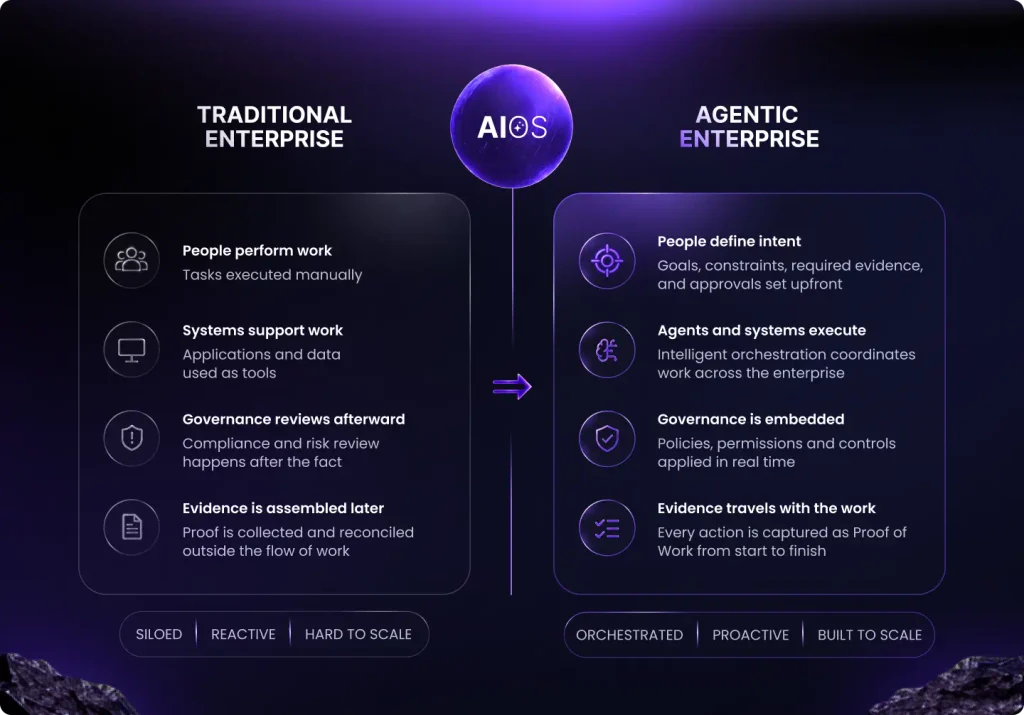
Figure 1: The Agentic Operating Model
The Agentic Operating Model organizes enterprise work from business intent to trusted outcome through governed orchestration, with governance, knowledge, connectivity, and proof embedded throughout execution.
Proof becomes part of execution
Perhaps the biggest shift involves proof.
Historically, organizations have assembled evidence after work was completed. Documentation, approvals, testing records, and audit trails were reconstructed from multiple systems to demonstrate that governance had occurred.
In an agentic operating model, proof becomes part of the work itself.
Evidence is created continuously as work progresses, making it possible to understand how work was requested, what context informed decisions, which agents participated, where human authority was applied, what changed, and why an outcome can be trusted. Rather than reconstructing activity after the fact, organizations gain a continuous record of how work was requested, executed, reviewed, and approved. Every action becomes inspectable. Every decision becomes attributable. Every approval becomes verifiable.
For regulated institutions, that distinction matters. As work becomes increasingly distributed across people and AI, maintaining a transparent record of how decisions were made is no longer simply a compliance requirement. It becomes the foundation for governance, accountability, trust, and responsible enterprise AI at scale.
Where do organizations start?
Very few organizations will redesign the enterprise overnight.
Most begin with one governed workflow, often software modernization, internal application delivery, or another evidence-intensive process.
They establish orchestration, governance, and proof in one area, refine the operating model, then extend it across additional workflows.
Evidence-intensive workflows provide a practical starting point because they allow organizations to test how authority, governance, human oversight, cost management, and proof of work function together before applying the operating model more broadly.
Every operating model requires an operating layer
A new operating model cannot remain a conceptual framework. It requires infrastructure capable of making it executable. As AI participates in enterprise work, organizations need a way to coordinate people, agents, models, knowledge, systems, and policies while preserving governance, authority, accountability, and trust.
That is the role of an operating layer. It turns business intent into governed execution, coordinates work across people and intelligent agents, and ensures that governance and proof remain part of the work rather than being applied after it.
For more than two decades, Zafin has helped some of the world’s largest and most highly regulated institutions modernize mission-critical technology. That experience taught us that technology is rarely the hardest part of transformation. The greater challenge is redesigning how work moves across the enterprise while maintaining governance, human authority, accountability, and trust.
As AI became an active participant in enterprise work, we encountered the same challenge ourselves: the problem was no longer deploying more capable agents, but operationalizing governed agentic work at enterprise scale.
That perspective shaped Zafin AIOS.
Rather than treating AI as another application to deploy, we designed AIOS as the operating layer for governed agentic work.
It coordinates approved agents, models, knowledge, systems, workflows, and people; applies governance; preserves human authority; provides cost visibility; and creates proof from intent to governed outcome.
AIOS operationalizes the Agentic Operating Model by providing the control plane that governs how work moves across the enterprise.
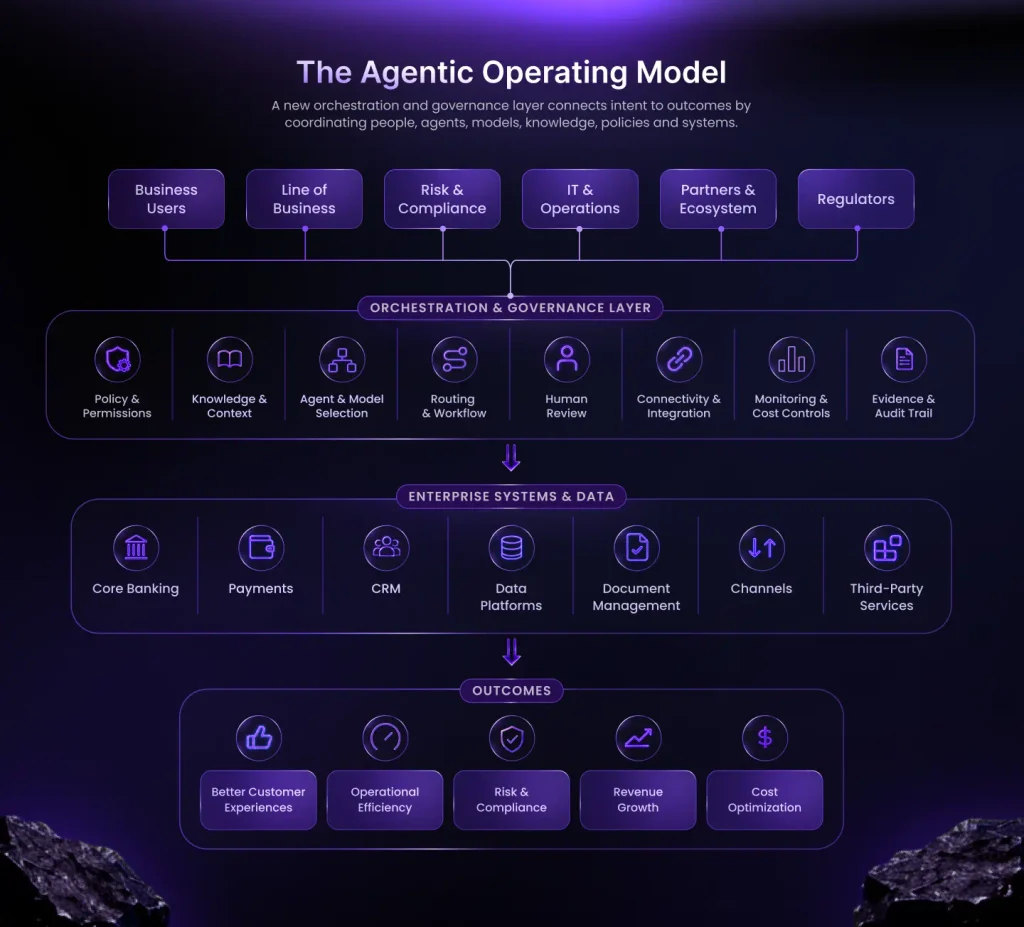
Figure 2. Operationalizing the Agentic Operating Model
AIOS provides the operating layer that coordinates people, agents, models, enterprise knowledge, systems, governance, and human authority to move work from business intent to trusted outcomes.
Redesigning work is the next enterprise advantage
Organizations that continue layering intelligent agents onto operating models designed exclusively for human work will undoubtedly increase AI activity. Many will improve productivity.
The organizations that lead the next decade, however, will redesign how work itself moves through the enterprise.
They will build operating models capable of orchestrating increasingly complex ecosystems of people, intelligent agents, models, systems, and enterprise knowledge. They will embed governance into the flow of work. They will create proof as work happens rather than reconstructing it afterward.
Every major technology shift has eventually reshaped how enterprises operate. Agentic AI will be no different.
Previous generations of enterprise software digitized work. Agentic AI changes who performs it, how it is coordinated, and where authority resides. The organizations that redesign their operating model around that reality will define the next era of enterprise AI.
The next competitive advantage will not come from better AI. It will come from a better operating model.
Explore Zafin AIOS: https://zafin.com/aios/