Whitepaper

Bank M&A is accelerating, but many institutions continue to struggle with a more fundamental challenge: preserving growth and customer value during convergence.
The central challenge facing bank M&A today is not identifying value, but realizing it. Curinos’ analysis of post-merger deposit performance shows a significant gap between top- and bottom-quartile integration outcomes. In the lowest-performing quartile, approximately 17% of deposits have left the combined institution within three months of conversion, highlighting how quickly customer value can erode when integration execution falls short.3
Value realization is not determined when the deal is announced. It is determined during the months that follow, when decisions around customer retention, product mapping, pricing, and technology migration directly influence whether projected synergies are captured or lost.
Banks do not lose value at announcement. They lose it during convergence when the end customer is disrupted.
The institutions that outperform are not simply better at systems integration. They are better at preserving growth while convergence is underway.
1
Customer movement insight, pricing benchmarks, segmentation, overlap analysis, and early visibility into where value is most at risk.
2
The ability to translate those insights into coordinated product, pricing, offer, and migration actions at speed.
Preserve growth. Protect customer value. Execute with intelligence and control.
AI is accelerating both sides of this model and is already being applied across M&A workflows including target analysis, diligence, integration planning, workflow automation, and customer segmentation. 86% of surveyed corporate and private equity leaders had integrated GenAI into M&A workflows5. AI may further support convergence through assisted migration sequencing, pricing orchestration, customer-level retention optimization, and real-time monitoring of integration risks.

The implication is clear: The next wave of bank M&A will not be defined only by which banks complete deals. It will be defined by the ability to preserve customer momentum, accelerate convergence, and transform modeled value into realized growth.
The traditional view of M&A integration focuses heavily on systems, operations, and conversion milestones. Those are necessary, but they are not sufficient. The more immediate risk is that banks enter a growth vulnerability window.
During this window:
Curinos’ analysis found that banks typically experience a 25% decline in new-to-bank (NTB) sales between deal close and conversion as acquisition activity slows and organizational focus shifts toward integration.
This is what makes M&A different from ordinary transformation. The bank is trying to converge internally while market pressures and needs are evolving and changing.
Curinos’ analysis of U.S. bank mergers above $5 billion since 2018
11%
Average consumer deposit attrition three months after Legal Day 1
17%
Bottom-quartile integrations exceeding 17% attrition
5%
Top-quartile performers limiting attrition to less than 5%
Certain balances, customers, segments, and relationships are more vulnerable than others. The risk is often visible before it becomes visible in the financial results.
The issue is not whether integration is completed. It is whether the bank can identify where growth is vulnerable early enough to act before value starts decreasing or deteriorating.
Once the growth vulnerability window opens, value erosion typically shows up in 3 connected ways.
First, the risk of customer disruption increases. Customers experience the merger through what changes for them:
Even modest friction can weaken confidence during a period when competitors are actively looking for opportunities to intervene.
Banks often pause or defer pricing actions during integration to reduce operational risk. That can be rational in the short term, but it creates a different risk.
Curinos’ analysis indicates that significant pricing strategy changes can depress balance growth for several months after implementation, reinforcing why pricing convergence needs to be sequenced carefully during bank M&A.
Relationship managers and frontline teams operate with unclear or fragmented guidance.
In commercial banking, this can be especially acute where treasury pricing, account analysis, negotiated agreements, and relationship economics require coordinated decisions.
When product and pricing logic remain embedded in core systems, convergence becomes tied to longer system timelines.
At the same time, data, pricing strategy, customer insight, and execution often sit in different places. The bank may know which customers are at risk but not be able to act quickly. It may understand pricing exposure but lack the execution model to harmonize consistently. It may define migration priorities but lack the operational control to sequence them effectively.
This is why convergence velocity matters. The longer customers, pricing, products, and operations remain misaligned, the more likely temporary transition issues become permanent value leakage.
Every bank M&A integration eventually faces the same question: how quickly can the combined institution converge customers, pricing, products, and operations without losing growth momentum?

This is not simply a speed question. Fast conversion can create the appearance of progress while deferring complexity. A slower, more controlled approach can reduce risk, but it can also delay value if it becomes overly cautious. The challenge is not speed at any cost. It is speed with control.
This is where the M&A conversation shifts from integration planning to convergence strategy.
If convergence velocity determines realized value, then convergence planning has to begin before Day 1.
Banks need to know where value is exposed before customers experience disruption. That requires visibility into:
This is where decision intelligence becomes critical.
The value of this approach can be seen in the impact of targeted intervention strategies.
By proactively identifying vulnerable customers and intervening before disruption accelerates, institutions can significantly reduce customer losses during conversion and protect revenue that would otherwise erode through the integration process.
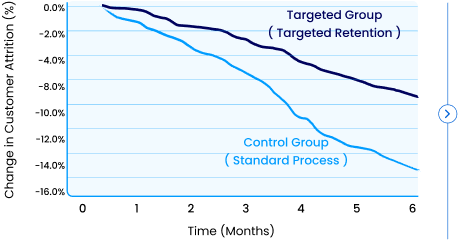
As shown in the chart, customers identified as high-risk and high-value through predictive analytics and segmentation experienced materially lower attrition when targeted retention treatments were applied.
“Comparison of a treatment segment versus a control group over time. Customers receiving targeted retention interventions experienced materially lower attrition than those following standard conversion processes, demonstrating the value of early identification and proactive engagement.” Source: Curinos.
Decision intelligence gives banks the ability to move from broad integration planning to prioritized convergence action.
It helps answer questions such as:
1.
Which customers are most vulnerable during transition?
2.
Which product or pricing differences create the highest risk?
3.
Which segments should be protected, migrated, or offered alternatives first?
4.
Where is acquisition momentum most likely to slow?
5.
Which commercial relationships require proactive pricing or RM intervention?
6.
Where can the bank rationalize early without creating unnecessary disruption?
This capability becomes especially important because the highest-risk decisions are often made before systems are fully integrated. Waiting for full conversion before acting means the institution is already reacting to disruption instead of shaping convergence proactively.
Banks need intelligence capabilities that combine customer behavior, pricing benchmarks, competitive context, segmentation insight, and portfolio analytics into an actionable view of convergence risk before customer disruption accelerates.
The institutions that perform best during convergence are typically those that can:
01
Provides an antitrust-compliant view of the combined portfolio before Legal Day 1, allowing banks to identify customer overlap, balance movement trends, and attrition risk earlier in the process.
02
Helps institutions understand where relationships, products, and balances intersect across the two organizations, enabling more informed retention, migration, and cross-sell strategies.
03
Identifies which customer segments are most sensitive to pricing, fee, or product changes, helping banks sequence pricing actions in a way that minimizes revenue leakage and customer churn.
04
Highlights high-value customer groups that are most likely to attrite during conversion, allowing relationship managers and marketing teams to prioritize intervention where it will have the greatest impact.
05
Helps determine which products, customer segments, and portfolios should be addressed first, reducing operational risk while accelerating time-to-value.
Together, these capabilities enable institutions to move beyond broad integration planning and make targeted decisions based on customer behavior, value concentration, and convergence risk.
The result is a more controlled integration process, faster value realization, and a reduced likelihood of revenue erosion during transition.
In an M&A context, these capabilities create decision advantage before convergence begins, helping institutions identify where growth, pricing, and customer value are most exposed and where intervention is most urgent.
Decision intelligence helps banks identify where value is exposed. But preserving value during convergence also requires the ability to respond consistently, quickly, and at scale.

Acquiring banks often inherit multiple core systems, duplicate product sets, fragmented pricing logic, and different governance models across lines of business.

Traditional integration approaches treat this as a sequencing problem: convert the cores, rationalize the products, then migrate the customers.

In practice, that sequence can create a long window where the bank is managing multiple operating models while trying to preserve growth.
The institutions that close this window fastest are those that separate product and pricing control from core system timelines. This does not eliminate core migration, but it changes the dependency model. Product definitions, pricing logic, eligibility rules, offer structures, and customer configuration can be governed through a common execution model while core conversion proceeds on its own timeline.
For M&A, this changes what is possible before and after Day 1. Banks can begin harmonizing pricing before systems are fully unified. They can rationalize duplicate products progressively. They can migrate specific customer segments in a controlled sequence rather than relying only on a broad cutover. They can enforce more consistent governance across both institutions while integration is still underway.
This is what convergence execution requires: not just a plan, but a persistent operating capability that can absorb complexity, rationalize it progressively, and deliver coordinated customer and pricing actions at each stage of integration.
The need for convergence execution is shared across the bank, but the risk pattern looks different in retail and commercial banking.
How growth vulnerability shows up in retail banking


The challenge is to identify which customers are most likely to
move, what actions will preserve the relationship, and how to personalize retention or acquisition strategies while the organization is in transition.
The stakes become even higher in business banking. Curinos benchmark data shows that attrition rates are consistently higher among small and medium business (SMB) banking customers than consumer customers during merger integrations.
Three months after conversion, median attrition rates reach 13.4% in business banking compared to 11.1% in consumer banking.
While bottom-quartile performers experience attrition of nearly 24% in business banking.
Much like the escalation of risk between retail and SMB banking, the stakes can get even higher at the commercial level.
In commercial banking, convergence risk often appears through
The challenge is not only to retain balances or customers but also to preserve relationship economics, pricing discipline, and client confidence during a period when competitors may be targeting the same accounts.
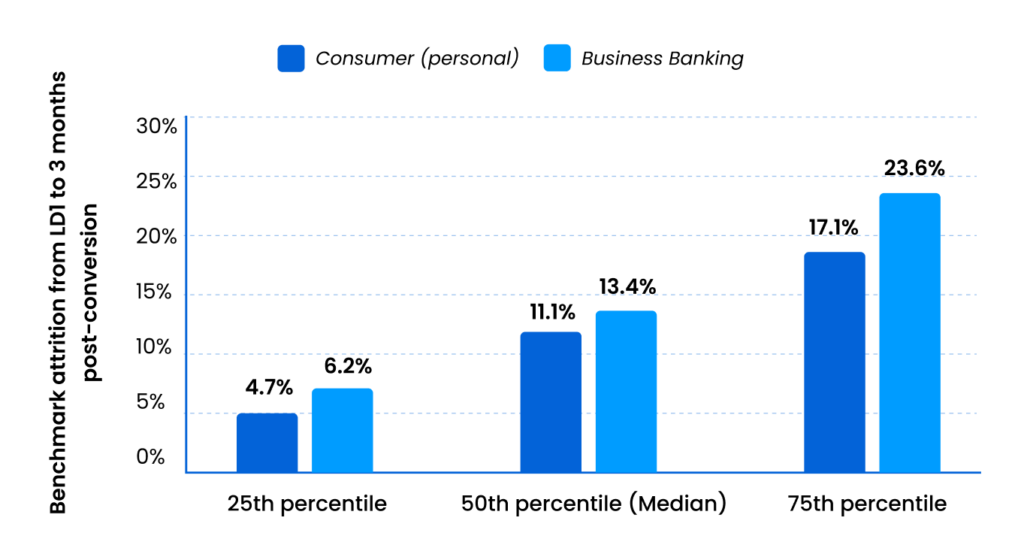
Curinos benchmark data shows significant variation in customer attrition during the first three months following conversion. Top-performing institutions limit consumer and business banking attrition to 4.7% and 6.2%, respectively, while lower-performing institutions experience attrition rates as high as 17.1% and 23.6%. The spread highlights how customer retention outcomes are shaped by integration execution rather than deal economics alone.
This retail-commercial distinction matters because it allows the M&A narrative to scale without becoming generic. M&A remains the trigger event, but the convergence challenge is expressed differently by line of business. A bank that understands these differences can plan more precisely, sequence more intelligently, and execute with greater relevance.
AI should not be positioned as a magic answer to M&A complexity. Its value is more practical and, for that reason, more credible.

The rapid pace of adoption reflects a broader recognition that competitive advantage increasingly comes from the ability to process information faster, identify risks earlier, and execute decisions with greater precision throughout the deal lifecycle.

Accelerating diligence and document review

Identifying customer and segment-level risk

Prioritizing migration and retention actions

Supporting compliance and disclosure workflows

Improving information access for frontline and advisory teams

Assisting integration planning and program management
Over time, AI may help banks move from static integration planning toward adaptive convergence orchestration. That could include AI-assisted migration sequencing, dynamic pricing harmonization, customer-level retention optimization, and real-time convergence monitoring. These are emerging opportunities, not claims of universal current practice.
The point is not that AI replaces strategy. It improves the speed, precision, and coordination with which strategy can be executed during periods of operational stress.
The strongest banks will not treat each merger as a one-off integration program. They will build repeatable convergence capability.

Decision intelligence before Day 1

Line-of-business-specific retention and growth strategies

Visibility into customer and pricing vulnerability

AI-enabled coordination and monitoring

Clear convergence strategy

Continuous learning from outcomes

Governed product and pricing execution
This is where the M&A discussion becomes larger without losing its anchor. M&A is the highest-stakes convergence event banks face, but the same operating model applies to other moments of disruption: market expansion, product rationalization, pricing transformation, loyalty reinvention, and digital migration.
The institutions that build this capability will be better positioned not only to complete deals, but to preserve momentum while the market is watching.

Banks that fail to build this capability will not simply integrate more slowly. They will lose the value of the deal. Banks that build it will extend that advantage beyond M&A into future moments of growth, disruption, and strategic change.
1. Ankura, “Banking Industry Outlook: U.S. Banking M&A Caps Off a Historic 2025.”
2. S&P Global Market Intelligence, “Bank M&A deal tracker: Q1 2026 on pace for highest value in 7 years.”
3. Curinos, “Every Deal is a Deposit Retention Strategy.”
5. Deloitte, “2025 M&A Generative AI Study.”
9. Deloitte, “2025 M&A Generative AI Study.”
10. McKinsey, “Gen AI: Opportunities in M&A.”
If you’re rethinking how your bank successfully manages M&A initiatives, we’d love to talk.
