




Over the next two decades, trillions of dollars will change hands, and the banking relationships attached to that wealth are far from guaranteed to follow.
Baby Boomers are expected to transfer as much as $124 trillion in wealth by 2048, with an estimated $80–90 trillion changing hands over the next 15 years. Yet for financial institutions, the Great Wealth Transfer is about more than where those assets ultimately land. It is also a massive test of whether relationships built with one generation can survive the transition to the next.
The risk is significant. 81% of next-generation millionaires plan to replace their parents’ wealth manager after inheriting. At the same time, younger clients are entering wealth with different expectations around digital experiences, advice, personalization, and access to alternative investments. The institution trusted by their parents is no longer the automatic choice.
And this transition is arriving as wealth businesses face pressure from multiple directions. Global assets under management continue to grow while profit per dollar of AUM declines, digital-first competitors are lowering barriers to wealth services, and client expectations are pushing institutions toward more holistic and personalized propositions.
The wealth will transfer. The relationship may not. For banks and wealth managers, the opportunity now is to build the relationships, capabilities, and experiences that give the next generation a reason to stay.
Five structural trends are reshaping the future of wealth management
Against this backdrop, five structural trends are changing how wealth is managed, creating a new set of priorities for financial institutions.
1. The shift to hybrid and digital advice
Customer preferences are reshaping how advice is delivered.
Demand for holistic advice continues to increase. The percentage of U.S. investors seeking comprehensive financial guidance grew from 29% in 2018 to 52% in 2023. At the same time, 73% of Millennials communicate with advisors digitally, while 90% of Millennials and Gen Z investors continue to use paid financial advice.
These trends point toward a hybrid model that combines digital convenience with trusted human expertise. Customers expect a consistent experience whether they engage through a mobile app, a self-service channel, or an advisor. Pricing, servicing, and relationship recognition should remain consistent across every interaction.
2. Fee compression and the race to “advice value”
Fee compression is reshaping where clients perceive value in a wealth relationship. As investment products become increasingly commoditized, financial planning, tax optimization, estate planning, integrated lending, and relationship-based advice are becoming more important components of the client proposition.
For banks, this creates an opportunity to build propositions around a broader understanding of client needs and goals, while creating greater value across the full financial relationship.
3. Expansion of private markets
High-net-worth and ultra-high-net-worth clients are increasingly looking beyond public markets as part of their investment strategies. Demand for private markets and alternative investments is growing across wealth tiers, with direct portfolio allocations to alternatives and private markets expected to increase by approximately 4–11 percentage points over the next 3 to 5 years, depending on wealth tier.
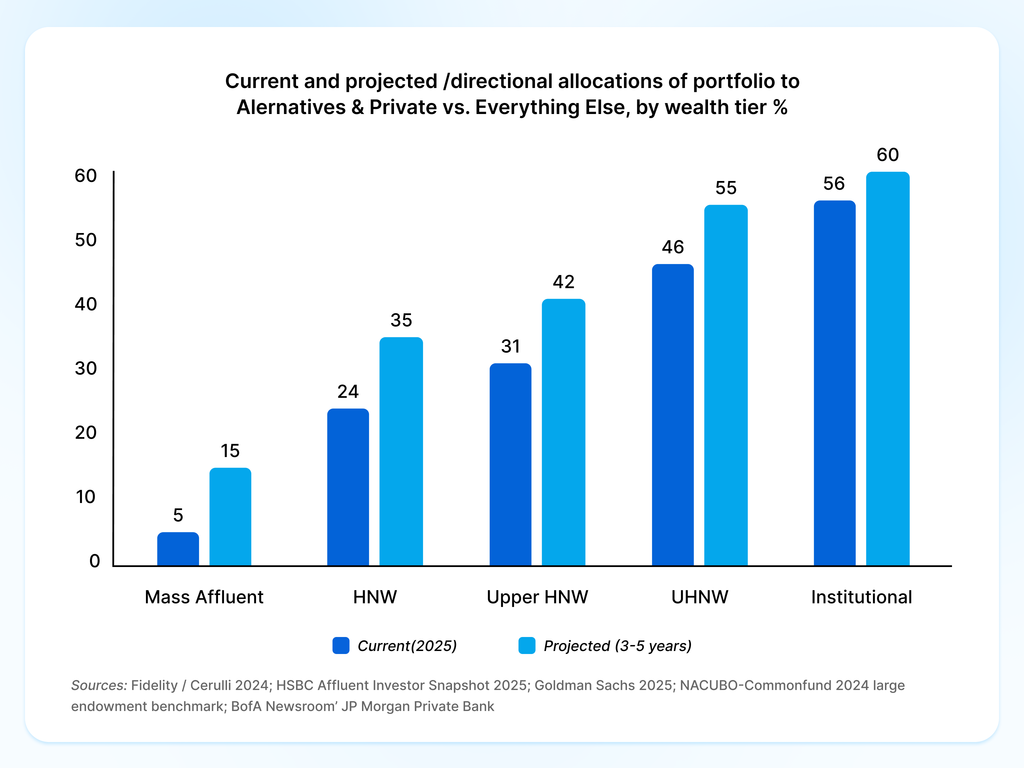
Access to these investments is becoming an increasingly important component of the wealth proposition. Institutions that can combine private market access with advice, lending, and other capabilities can create deeper relationships with clients whose needs are becoming more sophisticated.
4. Consolidation and the platform imperative
As wealth relationships become more complex, institutions are increasingly connecting banking, lending, investments, and advice through integrated platforms.
This shift creates a more complete view of the client and provides clearer pathways as customers move between wealth tiers. It also allows banks to recognize important changes in relationship value, life events, liquidity needs, and financial complexity, then adjust service models and propositions accordingly.
For customers, the result should be a more connected experience across their financial lives.
5. AI is restructuring the economics of advice
AI is also changing how advisors spend their time and how institutions think about advisor capacity.
Today, only around 20% of an advisor’s time is spent meeting with clients, with significant time dedicated to administration and research. AI-enabled tools are beginning to shift that balance by reducing the time required for activities such as meeting preparation, documentation, analysis, and follow-up.
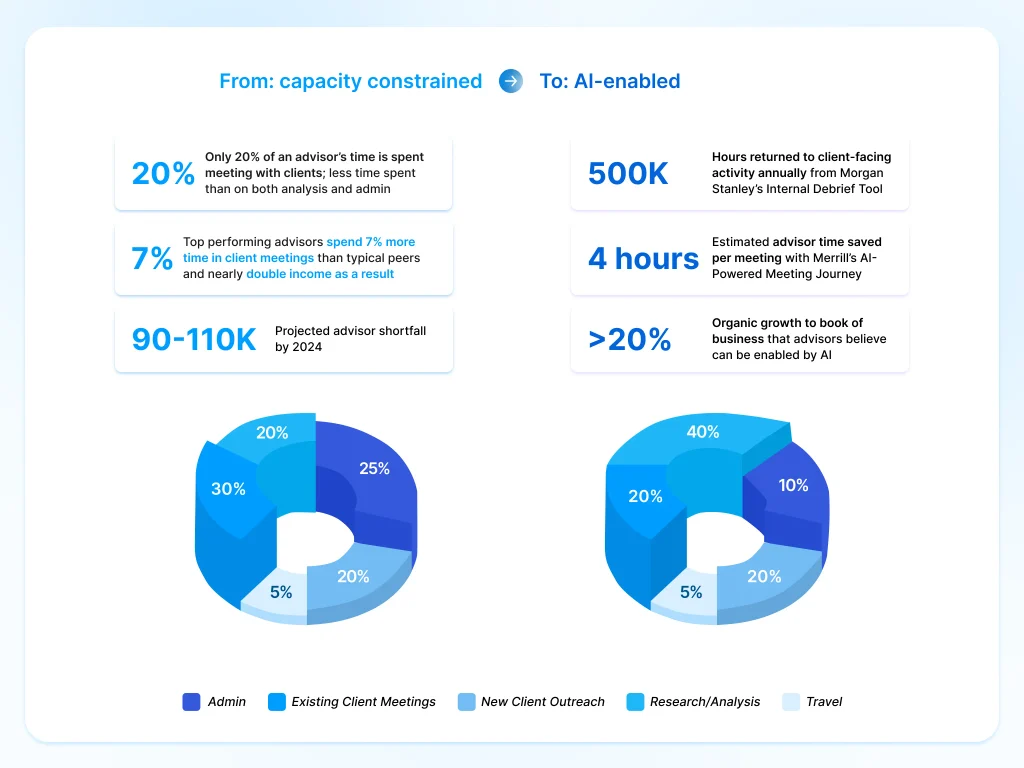
That creates an opportunity to return more advisor capacity to client-facing activities, allowing advisors to deepen existing relationships and pursue new ones. In a global industry facing an anticipated advisor shortfall of 90,000–110,000 by 2034, improving advisor productivity will become increasingly important.
What banks need to do next
Understanding these trends is only the first step. Leading institutions are redesigning how they build, grow, and serve wealth relationships, and there are four coordinated levers they are pulling.
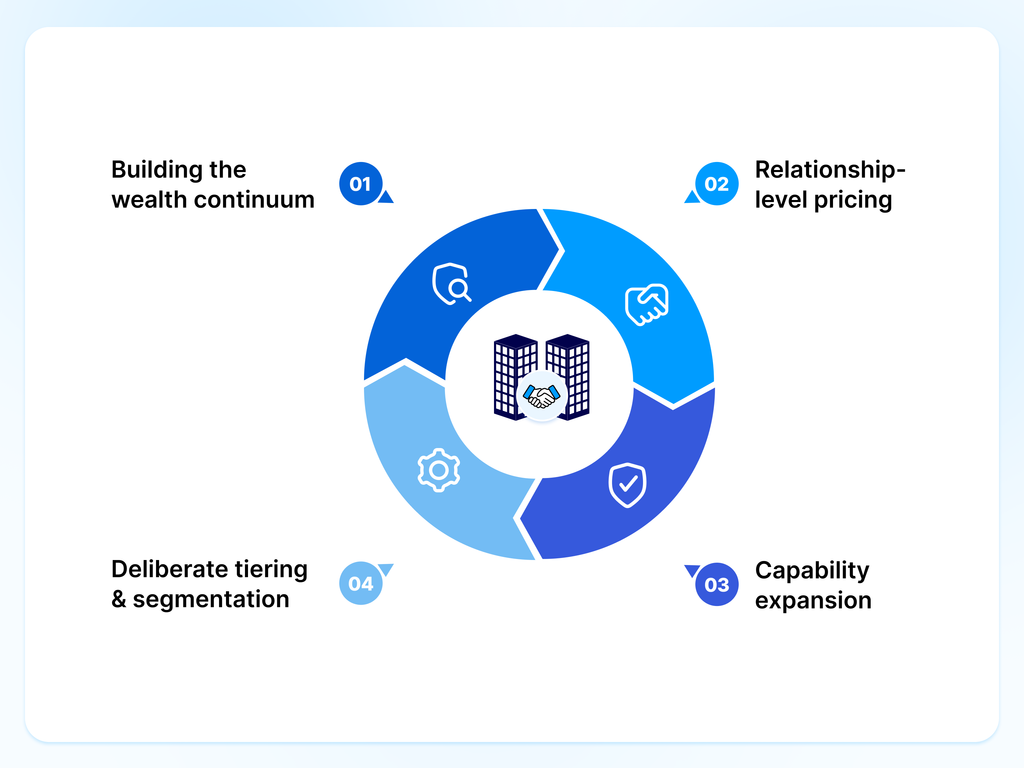
1. Building the wealth continuum
Many banks have traditionally viewed wealth management as a destination that begins once customers reach a specific asset threshold but have done little to build the cross-line-of-business infrastructure to facilitate the transition.
Leading institutions are expanding that perspective by building relationships much earlier and coordinating across Consumer, SMB, and Commercial Banking. They engage with affluent households, business owners, mass affluent customers, and the children of existing wealth clients, while building the cross-line-of-business referral infrastructure, triggers, and signals that identify when a customer is ready for a deeper wealth relationship. Wealth becomes a natural progression within an existing relationship instead of a separate acquisition strategy.
This approach creates familiarity and trust long before significant wealth changes hands.
2. Understanding the economics of the full customer relationship
Customers view their finances as one interconnected relationship. Their deposits, lending, investments, wealth, and long-term goals all contribute to a broader financial picture.
Banks increasingly need the ability to understand the complete customer relationship, including total profitability, household dynamics, and cross-line-of-business engagement. Relationship-level pricing and servicing provide a more accurate view of customer value while enabling more personalized offers and experiences.
Recognizing the entire relationship also creates opportunities to deepen loyalty across households and generations.
3. Expanding wealth capabilities
Leading institutions are also broadening the services they provide.
Private market access, holistic financial planning, tax optimization, estate planning, and integrated lending have become important components of the wealth experience. These capabilities support more comprehensive advice while strengthening customer relationships and improving long-term profitability.
4. Deliberate tiering and segmentation
Winning in wealth requires banks to define clear client tiers based on factors such as investable assets, total relationship value, household needs, and financial complexity.
Each tier should have clear thresholds, service standards, pricing, and benefits, with defined escalation pathways as a client’s wealth, needs, or relationship with the bank evolves. This helps institutions align the level of service with relationship value while avoiding over- or under-investing in different client segments.
Effective tiering also extends beyond the individual account. By understanding households and the broader customer relationship, banks can recognize when clients qualify for additional benefits, more sophisticated advice, or a higher-touch service model, creating a more deliberate path through the wealth continuum.
The future of wealth management is relationship-centered
The Great Wealth Transfer represents a significant opportunity for financial institutions, but retaining those relationships will require more than investment expertise. It will require banks to rethink how they organize, price, and serve relationships across lines of business.
That starts with building a clearer wealth continuum. Rather than waiting until a customer reaches a traditional wealth threshold, institutions can identify the signals that indicate increasing relationship value, from growing investable assets to business ownership, liquidity events, and changing family circumstances. Retail, commercial, lending, and wealth teams can then create deliberate pathways that move customers toward the right level of advice and service as their needs evolve.
Pricing and propositions need to evolve with that model. Product-by-product pricing provides only a partial view of a valuable relationship. Banks can instead consider deposits, lending, investments, AUM, and fee-paying services together, using total relationship value to inform pricing, benefits, and service levels. Tiering can make that relationship tangible, with increasingly valuable benefits and capabilities unlocked as the relationship grows.
There is also an opportunity to think beyond the individual customer. Householding can help institutions establish relationships with the next generation before wealth changes hands. Benefits earned by a high-value wealth client, for example, could extend to other members of the household through preferential pricing, fee waivers, lifestyle benefits, or access to selected wealth capabilities. Done well, the bank begins building affinity with an heir years before an inheritance creates an obvious wealth-management opportunity. This was one of the specific approaches raised in the SME conversation.
Making that work also has implications for teams and operating models. Retail, commercial, and wealth cannot function as disconnected acquisition and servicing engines. Shared customer signals, cross-LOB referral pathways, coordinated propositions, and clear ownership of relationship transitions become essential. A business owner should be recognizable as both a commercial client and a potential private banking client; the child of a wealth client should not first become visible to wealth when assets are transferred.
Finally, the proposition itself has to keep pace. As clients move up the wealth continuum, institutions need the flexibility to expand from standardized digital and hybrid experiences toward holistic planning, bespoke lending, tax and estate capabilities, and greater access to private markets and alternatives. The objective is a consistent relationship that can become more sophisticated without forcing the client to effectively start again with another part of the institution.
Financial institutions that bring these elements together can turn the Great Wealth Transfer from a one-time retention challenge into an opportunity to build generational relationships. Doing so requires the ability to recognize, manage, price, and grow the complete customer relationship across retail banking, commercial banking, lending, and wealth management. That is the foundation modern wealth leaders are building, and the foundation Zafin helps enable.