





Executive Summary
- Zafin moves offer launches from months to weeks without forcing any core-system change.
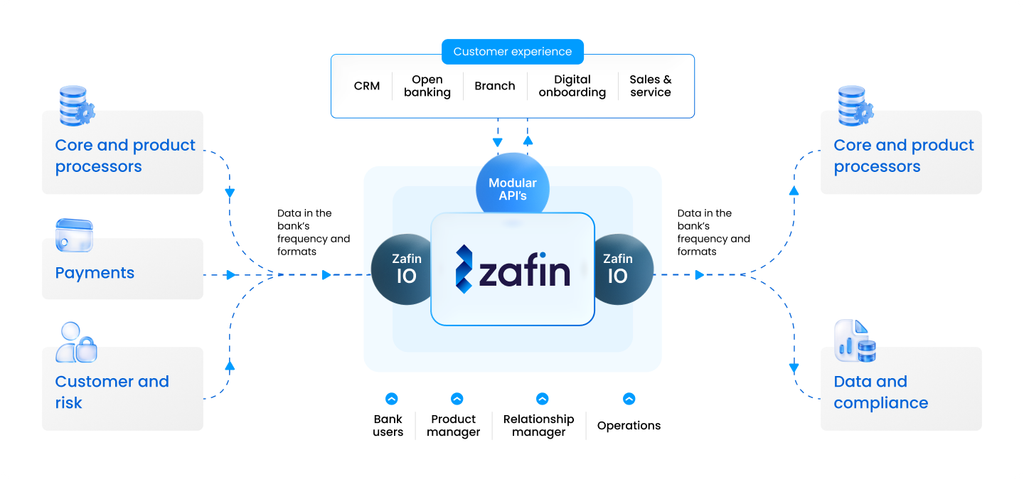
- Banks send data as-is, in their preferred format and frequency. Zafin IO handles ingestion, transformation, and schema drift.
- This creates a two-way data flow: data comes in from the cores or banking systems, the offer is configured, executed, and governed in Zafin, and results flow back to the core, CRM, MarTech, servicing, reporting, compliance, and other downstream systems.
- Every offer decision is transparent, traceable, and audit-ready, strengthening compliance and customer-service confidence.
- Zafin connects with core platforms like FIS, Hogan, Temenos, and Thought Machine, and customer engagement systems including Adobe Experience Cloud and Salesforce Marketing Cloud, while also supporting proprietary cores through configurable integration logic.
Introduction
With fintechs moving fast and customers expecting real-time personalization, banks are under growing pressure to launch targeted offers faster, respond to market and competitor moves, and personalize engagement across deposits, lending, bundles, and relationship-based programs.
Successful offer execution depends on many systems working together:
- Customer, account, balance, and transaction data may sit across core banking platforms, data lakes, and other enterprise data sources.
- Campaign journeys may run through CRM and MarTech tools.
- Eligibility may be checked through SQL queries.
- Exception pricing may live in spreadsheets, and fulfillment may depend on downstream operational systems.
When these steps are managed through disjointed manual processes and campaign-by-campaign builds, launching a new offer can take four to five months. Business teams may define the offer quickly, but data movement, rule configuration, eligibility checks, approvals, and downstream execution often rely on IT development cycles.
With Zafin’s Offer Management solution and Zafin IO, banks can move launch time from months to weeks.
How Zafin connects to your existing architecture
Zafin’s approach to integration rests on a simple principle: banks should not have to reshape their architecture, data formats, APIs, events, or operating rhythms.
Banks can provide data to Zafin in the format of their existing systems and in a frequency that they desire. That includes daily batch files, near-real-time event-driven processing, real-time API flows, or hybrid models, depending on the bank’s architecture and offer design.
Zafin IO ingests data from the bank’s existing systems as is, transforms it for offer execution inside Zafin, handles schema drift, and returns results back to the bank’s downstream systems in the desired format each one expects. This creates a two-way flow: data comes in, the offer is configured, executed, and governed in Zafin, and results flow back to the core, CRM, MarTech, servicing, reporting, compliance, and other downstream systems.
Part 1: Inbound: your data, in your format and frequency
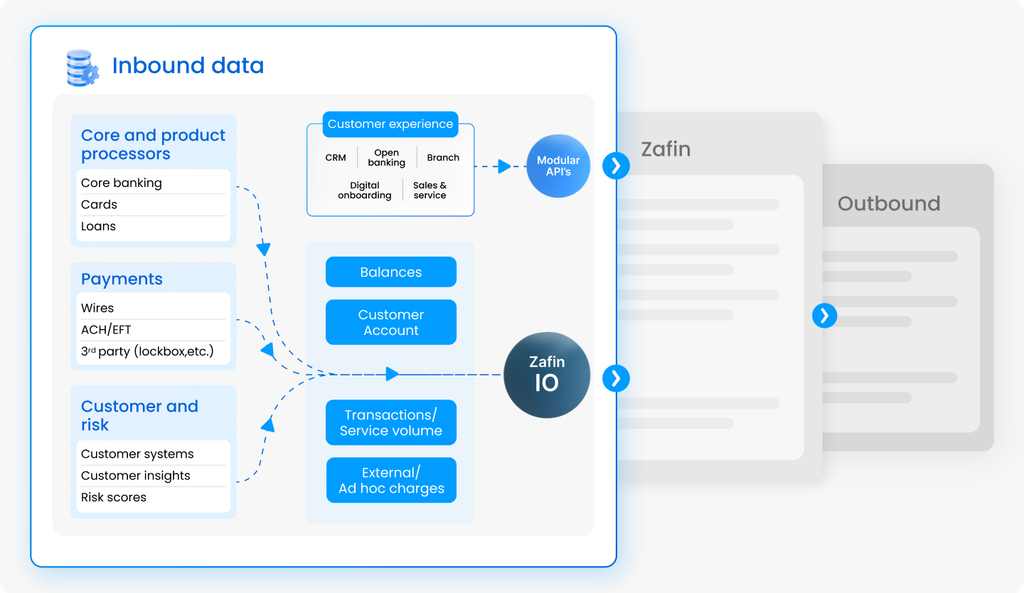
The inbound flow starts with the data required to evaluate and execute the offer.
Taking the example of a HISA Cash Bonus offer where the customer has to have a HISA and maintain a daily balance of $50K, they will get a reward of $50, the inbound data would include:
- Customer id & account id
- Product code and account status
- Account opening date
- Relationship rule (primary, non-primary, sole)
- End-of-day account balance
- Value date
- Closing balance and credit/debit code
Data can come from core banking platforms, data lakes, servicing systems, CRM and MarTech systems, product systems or other bank-operated sources in the form of end of day batch files, APIs, Kafka events, GraphQL flows, etc.
Zafin IO ingests the bank’s data as is, in the format and frequency that works for the bank and transforms it for offer execution.
This includes:
- mapping data into the structures required for offer execution
- handling changes to incoming schemas
- transforming information from multiple source systems into a consistent usable format
- supporting offer evaluation, enrollment, monitoring, reward calculation, and payout processes
Zafin connects with common core banking platforms including FIS, Hogan, Temenos, and Thought Machine. It also works with in-house and proprietary core systems through configurable integration logic.
A bank’s integration with Zafin IO is simplified with Zafin Canvas, an intuitive pipeline builder for such integrations. Zafin Canvas gives teams a governed way to design and manage integration pipelines using drag-and-drop functionality, reusable connectors and accelerators to the most common core systems, and pre-configured templates.
Teams can monitor pipeline runs, view integration status, troubleshoot issues, manage versions and identify exceptions early. This gives better operational visibility into how data moves through the integration flow while keeping pipeline design within a governed delivery model.
Part 2: Inside Zafin: end-to-end offer execution
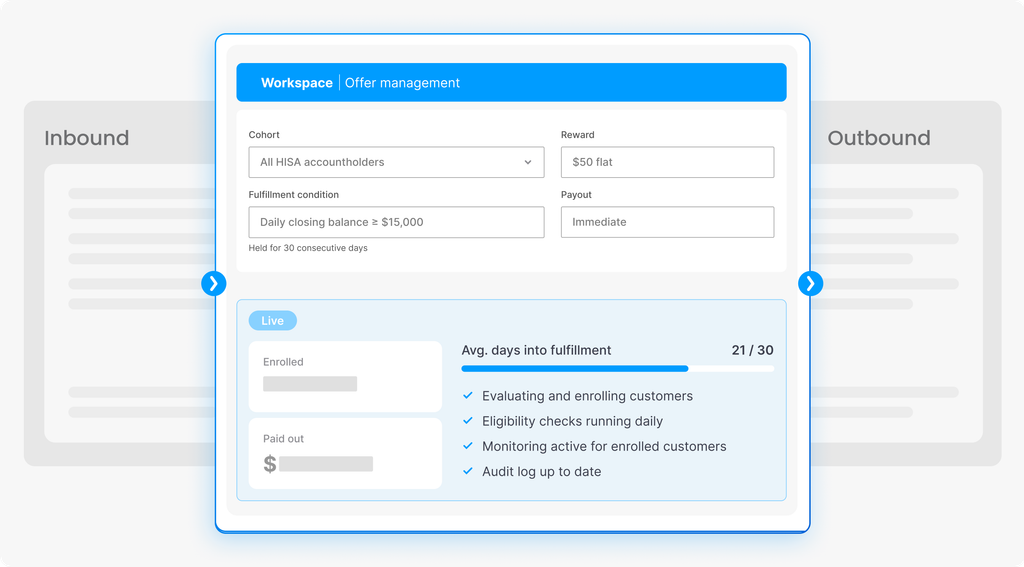
Once the required data is integrated, the bank configures and manages the offer lifecycle directly within Zafin. Banks can accelerate offer launches from SME-led setup to self-serve configuration in a single session, using pre-built, curated offer templates, AI smart tool tips, contextual inline guidance, automated guided workflows, and social tags & signals sourced from the market.
Configuration done by bankers
- Define cohorts and target populations
- Set eligibility criteria and enrollment rules
- Define monitoring rules
- Set calculation and payout rules
Execution by Zafin offer mgt. solution
- Evaluate customers against the configured eligibility criteria
- Track eligibility status for each customer
- Enroll qualifying customers based on the defined rules
- Monitor enrolled customers against fulfillment requirements throughout the offer period
- Calculate reward values when configured conditions are met
- Support payout execution according to the bank’s payout schedule
- Maintain controls, approvals, and auditability across the lifecycle
In this HISA example, the reward would be the flat bonus amount payout of $50:
- Define HISA account as the enrolment criteria
- Daily closing balance must be >=$15K for 30 days
- Set calculation as flat $50
- Payout set as “immediate”
Product, pricing, and marketing teams configure, manage, and govern the offer lifecycle directly within Zafin. Built-in controls, approvals, and auditability help the bank maintain compliance, operational oversight, and consistency across offers.
Part 3: Outbound: results in the format your downstream systems expect
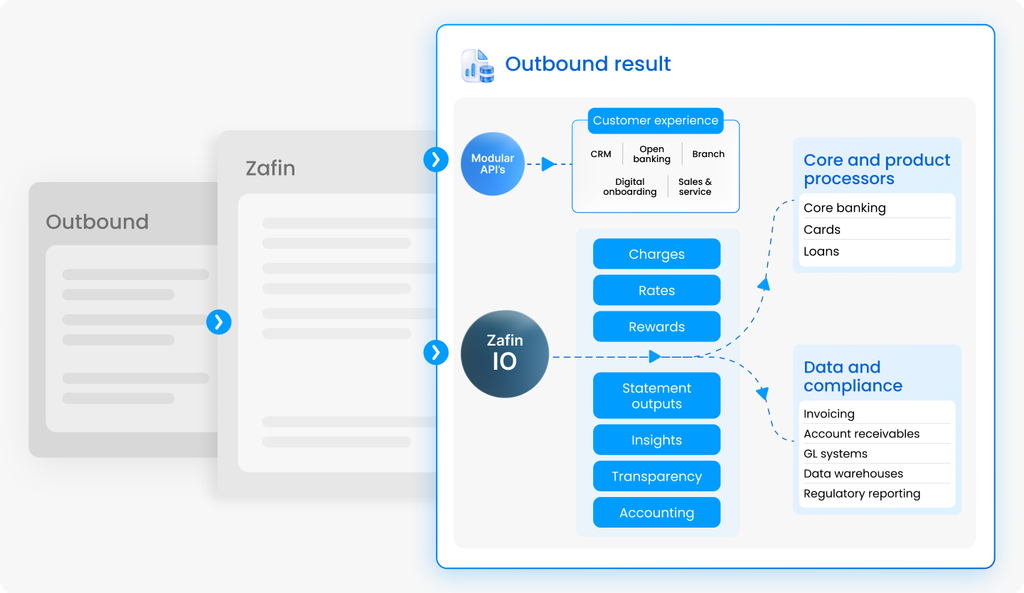
After an offer is evaluated and executed in Zafin, the results flow back into the bank’s existing environment. In this example the results would include:
- Enrollment status once enrolled
- Monitoring progress
- Monitoring fulfilment pass/fail status
- Calculated cash bonus amount
- Payout instructions and payout date
- Offer status transparency
These outputs can support fulfillment in the core, activation in CRM and MarTech systems, servicing workflows, reporting, compliance review, and other downstream processes.
This helps reduce manual effort by connecting offer eligibility, fulfillment tracking, reward calculation, and payout execution in one governed flow. On the customer engagement and servicing side, Zafin supports connectors and two-way API integrations with CRM and MarTech platforms, including Adobe Experience Cloud and Salesforce Marketing Cloud.
Transparency and compliance, built in
Banks need offer decisions to be explainable, reviewable, and traceable. When eligibility logic sits across spreadsheets, SQL queries, and campaign-specific builds, the evidence behind each decision can become scattered across teams and systems.
Zafin helps create decision-level transparency across the offer lifecycle. Each offer evaluation can capture the customer, the conditions checked, the outcome of each condition, eligibility status, enrolment decision, fulfilment status, and reward or payout status.
This gives support teams a clearer way to explain why a customer passed or failed an offer. It also gives compliance and audit teams structured evidence to support internal reviews and regulatory inquiries.
What this means for your bank
Integrating Zafin’s Offer Management solution allows banks to improve offer speed, control, and transparency while working within the architecture they already have.
Banks can provide their data as is in their existing format and in a cadence they prefer. Zafin IO handles ingestion, transformation, and schema drift. Zafin Offers executes the offer lifecycle from cohort definition and eligibility rules through enrollment, monitoring, reward calculation, and payout execution. Zafin returns results to the bank’s core, CRM, MarTech, servicing, reporting, compliance, and other downstream systems in the format each system needs.
The result is a more connected offer operating model, one where every offer decision is explainable, auditable, and ready to stand up to regulatory scrutiny.
The conversation starts wherever your bank’s architecture is today.
Talk to an expertFrequently Asked Questions (FAQ)
Zafin works within the bank’s existing architecture and data flows. Banks provide data in the format and frequency their systems already produce. Zafin IO ingests that data, maps and transforms it for offer execution inside Zafin, and then returns the offer outcomes back to the bank’s downstream systems in the format each system expects.
No. Zafin is designed to connect without changing the bank’s existing architecture. Banks can continue using their current data structures, files, schemas, and operating processes while Zafin IO handles ingestion, transformation, and schema drift through configured integration logic.
Zafin has established integration experience with major core banking platforms including FIS, Hogan, Temenos, and Thought Machine and more. Zafin IO also supports integrations with in-house and proprietary core systems through configurable transformation logic.
Yes. Banks can provide data in the format and frequency that works for their existing systems. Zafin IO can ingest data from core systems, CRM, MarTech tools, data lakes, files, APIs, Kafka events, GraphQL flows, and other bank-operated sources. Zafin then maps and transforms the data for offer execution and handles schema drift through configured integration logic.
Yes. Zafin works with the operating rhythm that fits the bank’s systems. Depending on the use case, architecture, and offer design, processing can run through daily batch files, near-real-time event-driven processing, real-time API flows, or hybrid models. Banks can also use different processing models across different stages of the offer lifecycle or across different offers.
Depending on the use case, banks send the customer, account, balance, transaction, product, pricing, campaign, and interaction data required to evaluate and execute the offer. Inside Zafin, teams define cohorts, associated rewards, eligibility criteria, enrollment rules, monitoring rules, calculation rules, and payout rules. Zafin evaluates customers, enrolls those who qualify, tracks eligibility, monitors fulfillment, calculates rewards, and supports payout execution.
Zafin then sends downstream outputs such as eligibility status, enrollment status, fulfillment status, calculated reward values, payout instructions, payout status, and decision-level records to the core, CRM, MarTech, servicing, reporting, compliance, and other systems in the format each expects.
Zafin has out-of-the-box/readily available connectors and two-way API integrations with customer engagement systems and MarTech platforms, including Adobe Experience Cloud and Salesforce Marketing Cloud. This helps banks connect offer execution with the campaign, journey, servicing, and engagement systems their teams already use. The specific integration approach depends on the bank’s architecture and use case.