




The corporate banking relationship manager has been underserved by technology for years. With the plethora of new AI-based tools, the question is what the role could become, not merely which of the current tasks can be automated.
“Past performance does not guarantee future results” is a standard regulatory warning, meaning historical gains or losses do not predict what will happen next. The same should apply to adoption of AI at financial institutions. Yes, there are risks with implementing new AI and agents, but an equally large risk is reimagining the future, but automating the past instead.
The banking industry is littered with projects where the future requirements for a new system were defined by what the existing/legacy system used to do – and what the upstream and downstream systems do. It happens in core banking, in payments, in revenue management. Capabilities are constrained by outdated processes, interfaces, and reports. If this is true of operational back-office functions, why should the roles in the front office be any different?
The corporate banking relationship and servicing teams have traditionally been underserved by tools and technology. It’s a high margin business that is relationship driven – a people business. The typical technology available was a CRM platform, a BI tool/dashboards, Microsoft Excel – and the rest of Office suite for correspondence and presentations. Oh – and a team of junior analysts who graduated top of their class in finance majors but spend all day churning on account analysis spreadsheets, and building PowerPoint presentations for the next quarterly business review.
Automation in support of these roles certainly helps, but banks also need to focus on the new expectations of their treasury clients. Is the goal of AI to automate RM activities (helpful in the short term), or to redefine how client relationships are managed?
Corporate client expectations have changed, holistic relationships are table stakes
Business clients increasingly expect banks to understand their full relationship with the bank across deposits, treasury services, lending, payments, cards, trade finance, custody, FX, etc. The challenge is not only product silos, but organization too. Pricing, billing, servicing, and relationship monitoring often operate separately, making it difficult for banks to manage the relationship as a whole.
For example, corporate clients have long demanded better transparency into fees and analysis, and banks were reluctant to give it. No wonder. Commercial and corporate banking pricing is typically custom for each client, with pricing negotiated through a deal management process, and is based on expected transaction volumes and balances. Even so, delivering billing information days or weeks after a month has ended is just in time for it to be useless to the customer.
But the shoe is now on the other foot. One of the first things corporate treasury teams did with generative AI was feed their analysis statements into it, to work out what their banks weren’t telling them. What happens to the relationship when the client shows up better informed than the banker? That’s a situation no relationship manager wants to be in.
In response, Celent research shows that banks are prioritizing the role of the RM team; ensuring they have better tools to manage relationships and be more advisory. In the past these roles were very underserved by technology, but AI and automation can transform that, along with a new vision for the future of relationship management.
AI is Transforming the Relationship Management Role
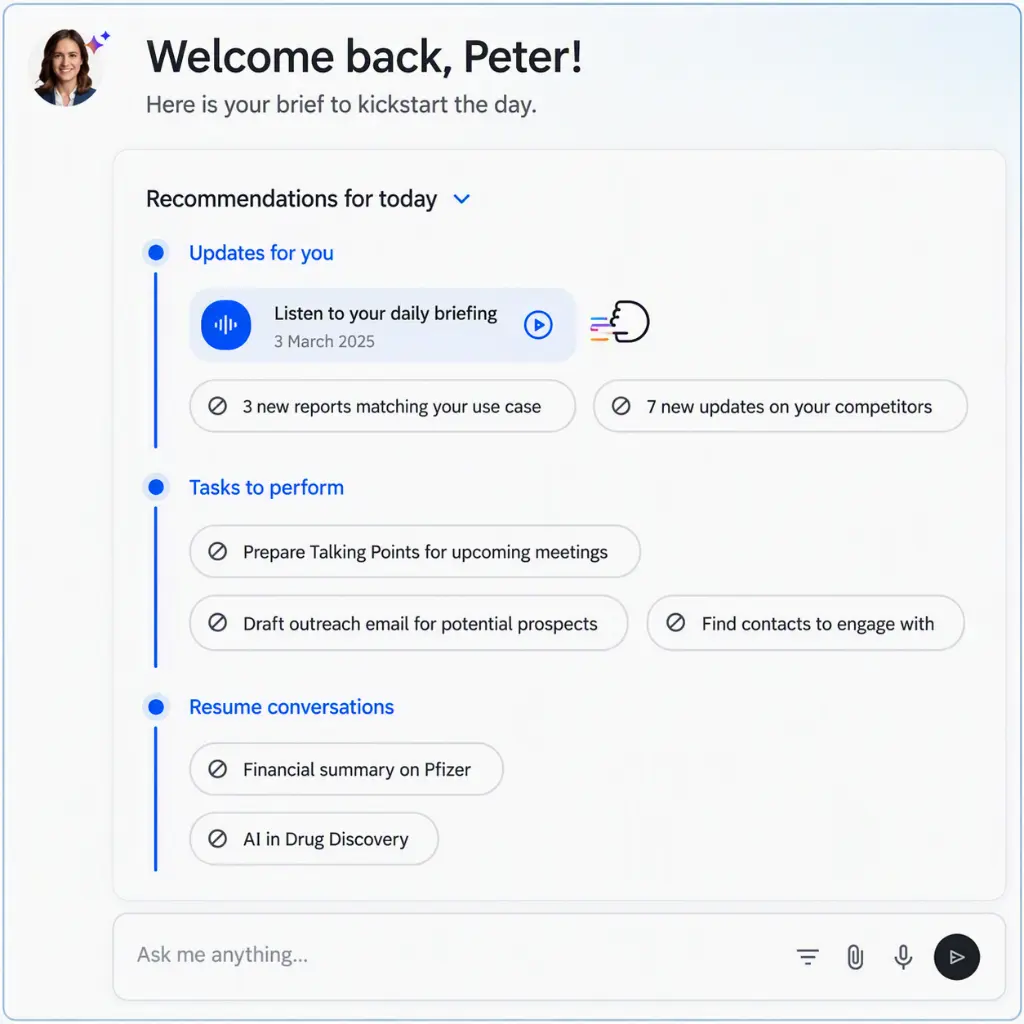
AI tools supporting bankers/relationship managers are maturing quickly across the value chain from targeting and client engagement to even performance coaching. Today, the most mature phase is client engagement thanks to AI tools that support knowledge search, information analysis, and content generation. The following graphic is a simple representation of how AI agents can take on relationship management activities.
Example of Agentic AI Tasks and Workflow Capabilities
Pre-GenAI: Spreadsheets, CRM, and BI
RM and analyst actions:
- Review call/meeting notes
- Review and update customer details in CRM
- Analyze pricing on spreadsheets or BI tool
- Look for prospects on LinkedIn
GenAI: Information synthesis and content generation
RM and analyst ask GenAI to:
- Summarize contact center transcripts
- Summarize a client’s financial report
- Prepare meeting notes
- Create a presentation for the quarterly business review
Agentic AI: Contextual memory, learning, and task execution
AI agent actions tasks:
- Automatically prepares a daily briefing
- Analyzes buying signals, looks up contacts in CRM
- Searches LinkedIn for new contacts and adds them to the CRM
- Creates an outreach campaign and draft emails/content
- Reads data from multiple sources, and writes to specific data stores
Source: Celent
The above focuses mainly on automation to enhance productivity. However, as the data analysis and interpretation of AI improves, Celent expects to see new advancements in deal management, pricing, onboarding, ongoing relationship building, and even coaching to evolve and strengthen relationship teams. Celent covers this in more detail in “AI Change Agents in Corporate and Transaction Banking” (June 2026).
The following graphic is an inventory of “relationship management” use cases for corporate banking being implemented today, but also those quickly emerging for the near future.
Who do I pursue?
What do I know?
What do I sell?
How do I prepare?
What should I say?
How do I win?
How do I expand the relationship?
How do I retain my clients?
How do I improve my skills?
How do I increase my performance metrics?
3 years
Source: Celent
Beyond the traditional banking relationship roles (but leveraging capabilities from sales organizations in other industries), AI also has the potential for completely new use cases for value creation – some that would not have been previously imagined (or possible). For example:
- Deal management. One of the early cases is in RFP analysis and response. AI can analyze RFP requirements, advise what deals have a high percentage of being won, and craft the response that’s tailored to the emphasis in the RFP scope (and/or existing relationship).
- Advise the advisor. AI can advise the relationship team on how to “pitch” new products and services – based on client gaps, relationship history, and sentiment.
- Coaching. An employee coaching capability can be embedded into RM activities and workflows. That coaching can be in context of how high functioning client relationships should look, and adaptive to the current relationship health.
Critically, in all these cases AI is not replacing human advisors, it strengthens them.
Looking ahead, scenario-based role play (e.g., where AI simulates a resistant CFO or skeptical credit officer) has the potential to fundamentally change how banks develop talent and skills. This is akin to the gamification paradigms adopted in recent years, but completely AI-driven. A better-coached employee should deliver better outcomes across every client interaction, and that in turn builds relationship value today and for the future.
In Response, Investment Priorities are Shifting
Celent’s annual Dimensions Survey of bank technology and product priorities highlighted a new trend. Client lifecycle management (CLM) has steadily increased in importance.
Percentage of corporate banks ranking CLM a top overall priority
Global
North America
Of course, CLM is a broad term that covers many aspects of the client relationship. If we consider this term to mean anything that manages the relationship and client satisfaction, this category has clearly moved beyond CRM tools, onboarding, and servicing – and includes deal and revenue management workflow. These functions weave horizontally across multiple verticals in the corporate bank (such as servicing, or revenue management). Although these roles don’t typically roll up to the RM – RMs are certainly interested in positive outcomes from each team!
Perhaps the question isn’t about automation for relationship managers and sales officers, but how technology can improve the whole client lifecycle by adding value to each of the constituent stakeholders? Deal management, relationship/sales management, revenue management, onboarding, servicing, operations to name a few.
This isn’t just about doing more task automation or defining who the RM is – it is redefining how client relationships are managed – and that has role consequences throughout that value chain.