
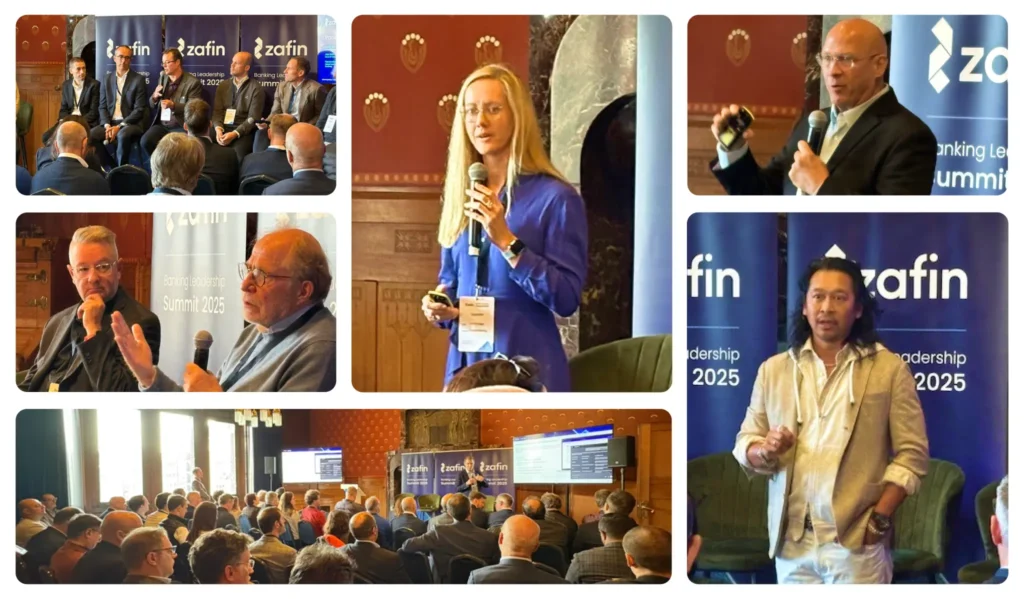
The Banking Leadership Summit Europe 2025 made one thing clear: European banking is at an inflection point. The topics focused on redefining the very foundations on which banks compete.
Across keynotes and conversations, our speakers acknowledged that banks capable of reshaping trust, embracing openness, and accelerating modernization boldly will be the ones that unlock the most value over the next decade.
Before diving deeper into the takeaways, watch this short highlight reel to experience the moments that defined Banking Leadership Summit Europe 2025.
Reframing Trust as a Competitive Advantage
At BLS Europe, trust emerged as a primary currency of competition. Banks have traditionally tried to engineer trust through perfect data and impeccable compliance, but that framework is insufficient for the world we live in now. Trust is becoming more human, more experiential, and more emotional.
As Michael Tang, our keynote speaker from Deloitte emphasized, customers don’t just want their bank to “know” them, they want it to understand them. They want to feel something. Leaders challenged the room to move beyond the narrow lens of “share of wallet” and instead measure “share of life,” a metric rooted in human connection rather than product distribution. The idea was simple but profound: in a world full of digital sameness, the banks that win will be the ones that make people feel seen.
And that requires looking outside the industry. Banks must study sectors where emotional resonance is baked into the brand, and apply that thinking to financial relationships that have grown too transactional for a world shaped by choice.
Open Banking and Innovation Through Combination
Open Banking discussions have historically centered on compliance and connectivity. This year, the conversation shifted toward commercial imagination. Sarah Häger from Enable Banking spoke about the strategic advantage that comes from combining financial data with entirely new datasets, and the competitive edge that comes from placing banking products where customers already live, work, and play.
The analogy drawn from fashion hit home: transformation accelerated not when they refined their stores, but when they reimagined distribution entirely. Banks must now ask: Why are we still assuming our channels are the default?
It’s time to treat banking as a platform, not a destination. When products can surface in a coffee shop, a digital marketplace, or an unexpected ecosystem partnership, banks stop competing on sameness and start competing on relevance.
And in payments and FX, the shift is already underway. With transparency on fees and new competitive entrants, customers are beginning to save thousands of euros simply by switching. Banks that cling to legacy pricing models will watch that value walk out the door.
Technology as Message: How Tools Shape Expectations
Another perspective from Shahir Daya, Zafin’s CPTO, emphasized that the tools banks design—and the ones customers ultimately use—shape not only the experience but also how customers perceive their institution.
Echoing McLuhan’s “the medium is the message,” Shahir noted that while banks engineer technology to enable authentic, human-centered interactions, customers’ expectations are shaped by the tools placed in their hands.
This relationship between design and usage emphasizes the importance of crafting experiences that reinforce trust, transparency, and connection.
AI as an Accelerator of Value
Unsurprisingly, AI featured prominently throughout the Summit, but with a focus on its real-word value. Rob Dunlap, Zafin’s Head of Product Innovation, described how modular, externalized platforms paired with AI are enabling banks to deliver business value faster than ever.
AI is helping teams move at greater speed, build better products, and optimize performance in ways that shift time and attention toward customer value creation. It’s both an efficiency lever (automating complexity) and a growth lever, helping banks design more relevant, responsive, and personalized propositions. The institutions that invest now in modular and AI-enabled foundations will be best positioned to move from reactive improvement to proactive innovation.
Rethinking Banking Business Models
The panel on business model reinvention acknowledged a paradox: banks need partnerships to grow, yet partnerships can dilute the primacy they depend on. Incumbents are grappling with how to leverage ecosystems without becoming interchangeable, while challengers are trying to grow quickly without cannibalizing their core propositions.
The message? You cannot cling to primacy while treating partnerships as bolt-ons.
True ecosystem leadership requires clarity on who you serve, where you differentiate, and where collaborations amplify your strengths. Anything less leads to strategic drift.
The Evolving Nature of Fraud and Customer Vulnerability
With Constantin von Altrock leading the discussion, fraud emerged as a significant area of concern as criminals grow more sophisticated in mimicking normal customer behavior. With every euro lost to fraud costing the bank three to four times as much, leaders underscored that customers, not payment channels, are increasingly the weakest link.
Because criminals adapt quickly, banks must create proactive strategies that encourage safer customer behavior. Rather than relying exclusively on risk scoring or behavioral analysis, speakers including Constantin…suggested that banks need to incentivize positive actions such as enabling two-factor authentication, completing employee security training, or adopting protective tools. Understanding genuine customer behavior patterns can make it harder for fraudsters to hide and easier for banks to detect subtle anomalies.
Loyalty in an Ecosystem Era
Another major theme centered on how loyalty is changing in an age where customers build their own financial ecosystems. Traditional assumptions, like using tenure as a proxy for loyalty, no longer hold true.
Younger generations increasingly look to social media and influencers for financial guidance, while older generations hold significant wealth that will largely be transferred rather than earned.
Carson Kotnyek, Zafin’s VP and Head of Ecosystems and Loyalty, posed important questions: How do banks become more than a place to pay bills? How can they reward the totality of the relationship, not just product-level interactions? And what new forms of value, such as memberships, digital perks, or cloud credits, can banks deliver to reinforce loyalty in a model where customers have more choice than ever?
Strategy, Technology, and the Realities of Execution
Throughout the sessions, speakers were candid about the evolving challenges of strategy and execution. Many emphasized the importance of disciplined in-person collaboration, especially when teams are building complex products and navigating scarce time. Rethinking funding models was another priority: traditional allocation structures often create fragmented accountability, whereas modern transformation requires shared objectives and shared ownership.
Executive alignment—from shareholders to boards to frontline teams—was cited as essential to avoid friction and ensure momentum. Leaders stressed that while incremental change is manageable, true industry leadership requires bold decisions and ambitious but achievable targets. Pricing excellence also surfaced as a differentiator, with thoughtful, well-resourced pricing teams offering both performance gains and internal influence to drive larger strategic bets.
Core Modernization as Strategic Enabler
Core modernization took center stage as a strategic enabler rather than a technical project. A composable, open core is no longer a nice-to-have—it is the foundation for speed, agility, and new value creation.
Don Free from Hawkeye Banktech Advisory noted that modernization paths vary widely, but one truth applies universally: success requires senior leadership at the table, actively championing and steering the approach. Without that commitment, modernization becomes an IT instead of a business transformation project.
Commercial Banking Priorities: Solving Revenue Leakage
Commercial banking leaders also shared insights on how modern pricing and billing capabilities are transforming performance. Modern infrastructure helps eliminate revenue leakage, improve transparency, and unify deal, product, and billing data into a single profitability lens.
By externalizing complexity and automating reconciliation, banks reduce operational drag and redirect resources toward growth. These investments are increasingly seen not just as operational upgrades, but as strategic levers for revenue acceleration.
What Banks Agreed On
Across the Summit, a consensus formed: banks must be simultaneously incremental and fearless. They must fix today’s challenges while making tomorrow’s defining bets. Executive alignment is mandatory. Transparency is becoming a board-level demand, not a suggestion. And the institutions that thrive will be the ones that combine human understanding with ecosystem ambition, modern platforms, and courageous decision-making.
As European banks navigate a rapidly evolving landscape, shaped by technology, competition, customer expectations, and shifting economics, the institutions that accelerate modernization and deliver meaningful human centered value creation will be best positioned to unlock opportunities in the years ahead.
Our Banking Leadership Summit North America is fast approaching! Join us in Charlotte, North Carolina March 18-19 2026 to continue shaping the conversation on the future of banking.