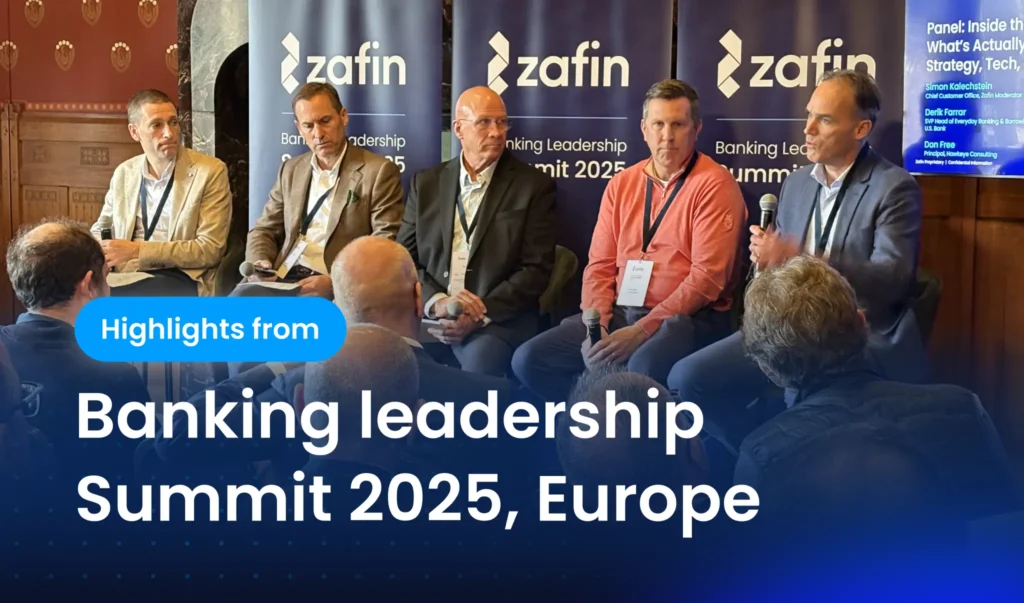


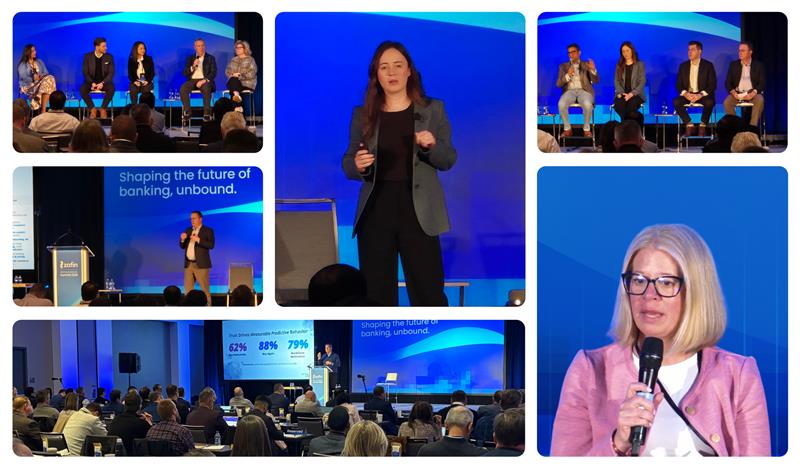




As the conversations at our latest Banking Leadership Summit bore out, the banking industry is entering a new phase of structural change. Competitive dynamics, customer expectations, and technological capabilities are evolving alongside each other, challenging long-standing assumptions about how banks create value.
Insights from our latest Leadership Summit point to a clear shift. The industry is moving beyond product-led growth toward a model defined by trust, real-time decisioning, and relationship-based economics where pricing, AI, and experience are converging to define how banks deliver value across the entire customer lifecycle, from onboarding to advocacy.
Here are some of the key insights our speakers shared:
Primacy is being redefined
For years, banks have defined success through product expansion: more accounts, more transactions, more share of wallet. That definition is quickly becoming outdated.
As switching friction declines, price comparison becomes instantaneous, and new competitors enter the market, primacy is no longer about how many products a customer holds, it is about who owns the relationship.
Leading institutions are responding by shifting their focus from product penetration to relationship depth. Growth is increasingly tied to engagement, relevance, and the ability to remain the customer’s primary financial partner, not just one of many providers.
This shift is also reflected in how industry leaders are thinking about growth. Insights from a poll conducted at our summit indicate the most selected growth driver over the next five years was loyalty-led relationship depth, reinforcing the move away from product expansion toward deeper, more meaningful customer relationships.
This reinforces a broader industry shift, highlighted in McKinsey’s perspective, where the ultimate objective is not simply automation or scale, but owning the customer relationship in an increasingly AI-mediated environment. As highlighted in Carson Kotnyek’s, Global Head of Industry Advisory at Zafin, session, this shift requires banks to think beyond individual moments and instead design for the full customer lifecycle, ensuring value is delivered consistently from onboarding through to long-term advocacy.
Trust is becoming an economic driver
Trust has long been viewed as a brand attribute. Today, it is becoming a measurable driver of performance.
Customers are more likely to buy from, stay with, and deepen relationships with institutions they trust. But some financial service providers continue to operate with a trust deficit.
What is changing is how trust is delivered. Rather than being communicated through messaging, it is being embedded into the customer experience, through clarity, consistency, and relevance across every interaction.
As highlighted by Gys Hyman, Principal at Deloitte, in his keynote trust must permeate the entire customer journey, reflecting a shift from competing on products to competing on how consistently and transparently banks deliver value for customers across every interaction.
Interestingly, while trust is recognized as critical, summit polling suggests it is still under-leveraged as a strategic priority. Only a small portion of respondents identified “turning trust into a measurable competitive asset” as the defining factor for future leaders, highlighting a gap between its importance and its execution.
The implication is clear: trust is moving from brand promise to operational capability, but not all banks have fully operationalized it yet.
Across all of it, the differentiation wasn’t features, it was execution. What consistently emerged is that leaders are separating themselves through execution—moving faster, responding to customer context in real time, and operationalizing these capabilities at scale.
Pricing is moving to the center of strategy
Pricing is undergoing a fundamental transformation. Historically managed in siloed functions, it is now emerging as a core strategic lever.
Banks are moving away from static, transaction-based models toward more dynamic, relationship-oriented approaches. Real-time pricing, segment-specific strategies, and subscription-like models are becoming more common. This shift also requires moving beyond manual, reactive processes toward more automated and governed pricing models that can respond to market changes in real time.
As noted by Joel Jose, Senior Manager from PwC, fragmented pricing approaches can limit growth, making the shift toward more cohesive, segment-driven pricing strategies essential.
Stephen Popiela, Principal from Deloitte also emphasized the industry’s movement toward platform-style subscription models, aligning pricing more closely with ongoing value delivery. At the same time, transparency is becoming non-negotiable. Customers expect pricing to be clear, fair, and aligned with value.
These shifts are equally pronounced in corporate banking. Discussions led by Zafin speakers, Rebecca DiPasquale, Dan Gill, and Geries Moukarzel highlighted the growing need for consistent, relationship-based pricing across complex portfolios, where value must be articulated across multiple products, services, and client interactions, and where segmentation and automated rate management are critical to avoiding margin leakage and staying aligned to market dynamics.
As a result, pricing is no longer just about revenue capture. It is becoming central to how banks engage, differentiate, and retain customers.
AI is accelerating decision velocity
AI is already reshaping how banks operate, but its role is rapidly evolving.
The conversation is shifting from efficiency gains to decision-making capability. Banks are using AI to enable real-time segmentation, predictive pricing, and faster product innovation.
As Shahir Daya, our Chief Product and Technology Officer noted, the industry is at an inflection point where AI is transforming how products are designed and delivered, compressing innovation cycles and enabling faster responses to market change.
This aligns with McKinsey’s perspective that the true impact of AI lies not only in efficiency, but in reshaping how decisions are made and how value is created across the enterprise.
Interestingly, summit polling shows that most leaders still see AI’s immediate impact in internal productivity and operational efficiency, rather than revenue growth or pricing optimization.
This highlights an important tension: while AI’s long-term value lies in decisioning and growth, many banks are still focused on near-term efficiency gains.
The emerging differentiator, however, will be the ability to move beyond efficiency and achieve decision velocity at scale while maintaining control, governance, and trust.
Transparency is becoming a source of competitive advantage
Customer expectations around transparency are rising across every dimension of the banking experience.
From pricing clarity to explainable decisions and real-time financial insights, customers want greater visibility into how products work and the value they receive.
This shift has direct commercial impact. Transparency influences onboarding, retention, and advocacy, making it a driver of growth rather than just a compliance requirement.
Banks that can deliver transparency effectively are better positioned to build trust, strengthen relationships, and differentiate in an increasingly competitive market.
Banking is moving toward platform-based economics
A broader structural transition is also underway. Banking is beginning to move away from transaction-based revenue models toward platform-oriented economics.
As reflected across summit discussions, pricing and business models are shifting toward subscription, usage-based, and value-linked structures.
This direction is strongly reinforced by summit polling, where the majority of respondents identified redefining how value is delivered across every channel as the most important characteristic of future-leading banks.
In many ways, this brings banking closer to digital platform models, where value is continuous, and customer relationships are long-term by design. As discussed in Carson Kotnyek’s session, delivering value across the customer ecosystem requires banks to move beyond product silos and orchestrated experiences across onboarding, engagement, and retention, ensuring consistency and continuity across every stage of the relationship.
Profitability pressures are accelerating the shift
Macroeconomic conditions are reinforcing these changes. Margin compression and rising costs of growth are forcing banks to rethink how they optimize performance.
As noted by Peter Serene, Managing Director from Curinos, growth is becoming more expensive, and lower-rate environments are not providing the relief many expected. This is driving a greater focus on relationship-level profitability, more deliberate segment prioritization, and a renewed emphasis on deposit ownership and primacy.
Mary Ellen Georgas-Tellefsen, Senior Managing Director at Webster Bank highlighted in her session that this often means anchoring the relationship through deposits, reinforcing the importance of being the primary financial institution.
However, as Daniel Goodman, Head of Deposit Strategy at Valley Bank emphasized, executing on this strategy remains a challenge. Many banks are still constrained by fragmented systems and manual processes, making it difficult to launch and manage offers efficiently and respond to market opportunities in real time.
Modernizing the core to enable the future model
Underlying many of these shifts is the need for core modernization.
Legacy systems continue to limit pricing agility, real-time decisioning, and the ability to deliver integrated, relationship-level experiences.
As highlighted by Hanif Shariff, Industry Advisor at Zafin, a key part of this challenge. Many banks still rely on manual, fragmented processes that slow down time to market and introduce risk.
This creates a fundamental tension between speed and control, where the need to launch competitive offers quickly often conflicts with regulatory and compliance requirements.
Banks are increasingly moving toward modular, composable architectures and externalized pricing and decisioning capabilities that enable faster innovation and greater flexibility.
A new model for growth
Taken together, these themes point to a clear direction for the future of banking.
The industry is shifting from product-centric growth to a model defined by trust, real-time decisioning, and relationship ownership. Success will depend on how effectively institutions can align these capabilities: bringing together pricing, AI, and experience into a cohesive strategy.
The question is no longer whether transformation is needed, but how to execute it.
Those that can move beyond efficiency-driven change toward rethinking how value is delivered, how relationships are built, and how decisions are made and operationalized at scale, will be best positioned to compete in the next era of banking.