

Treasury Sales teams, you’re the ones bringing in the business. Every relationship you win, every deal you negotiate, every balance you attract is what drives treasury growth. You’re the face of the bank for your clients, turning conversations into revenue and relationships into primacy.
But too often, the systems meant to support you are working against you. The pricing you negotiate doesn’t always make it into billing accurately. Discounts stay active long after they should have expired. Balance commitments go untracked. And when those gaps add up across hundreds or thousands of clients, your bank loses revenue it should be earning.
That’s revenue leakage. Money slipping through the cracks not because anyone missed a sale, but because disconnected systems and manual processes couldn’t keep up. And when the bank’s numbers fall short, it doesn’t just affect the balance sheet. It affects your team’s results and your commissions.
You’re out there doing the hard part: winning business, building trust, and driving deposits. You shouldn’t have to lose earnings because the system can’t hold up its end of the deal.
It’s time for that to change.
Here’s the Reality for Treasury Sales Today
Across every conversation with banks, we hear the same thing repeatedly: you spend more time chasing clarity than closing deals.
One banker told us:
It wouldn’t have to do much to be a lot better than what we’re working with now.
Another said,
We do everything manually— spreadsheets, notes, whatever it takes to stay on top of deals.
Let’s look at what that really means in your world.
Stage 1: Preparing for the Conversation
What your world looks like today:
You start with a pricing review or a new opportunity. You look up the bank’s standard pricing, but it’s stored in one file while previous deals live in another.
The last version of the client’s agreement? Buried in an email chain or Salesforce note. You walk into the meeting with fragments of information instead of a full picture.
What it should look like:
You open a single view that brings it all together — balances, activity, historical pricing, and profitability. You see standard pricing instantly, along with what’s flexible and what’s not.
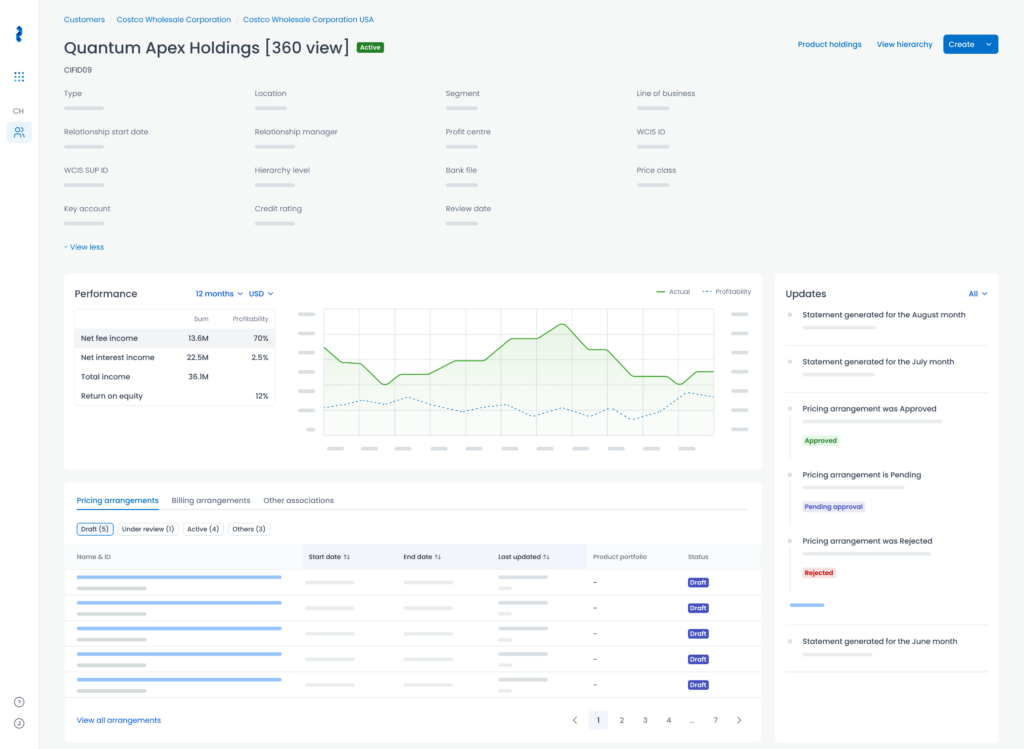
You know what to offer, what to protect, and what levers to pull before the conversation even starts.
Stage 2: Structuring the Deal
What your world looks like today:
You rely on outdated spreadsheets or static rate sheets. Approval thresholds aren’t clear, so you either over-discount or wait days for someone to confirm.
One banker told us,
If we move a standard price from A to B, we have no way to see the client-level impact.
That uncertainty slows you down. When the only lever you can pull is price, every negotiation turns into a race to the bottom. Competing on price alone not only eats into margin, it also commoditizes the relationship you’ve worked hard to build. Clients stop seeing strategic value; they just see another quote.
What it should look like:
You model “what-if” scenarios in real time. Adjust rates, volumes, or balances by comparing them to competitive pricing benchmarks and instantly see how it affects both the client’s cost and the bank’s revenue.
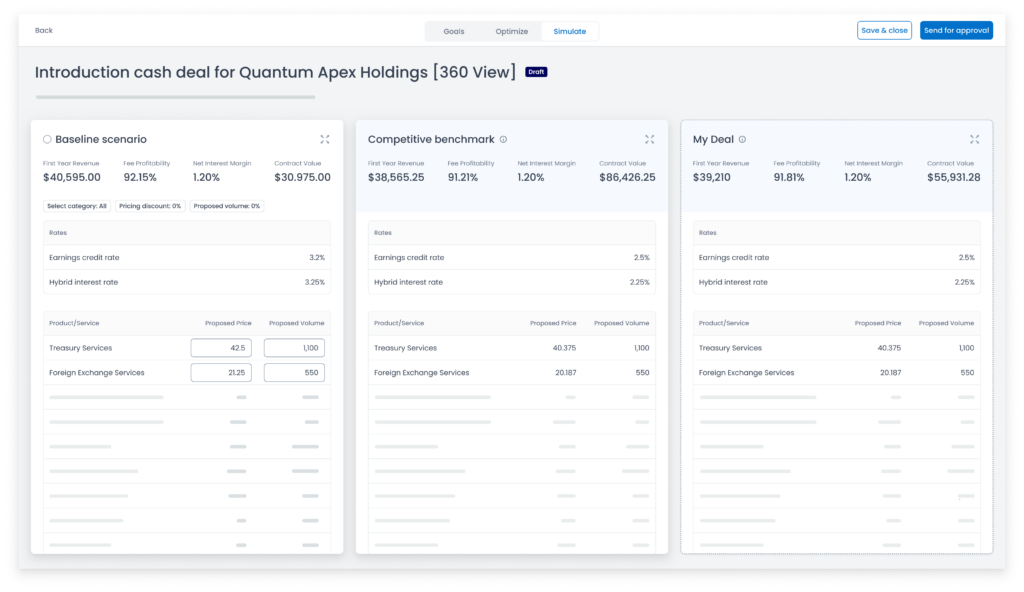
You walk into every deal discussion with the confidence to compete on insight, not on price.
With visibility into performance and profitability, you can show clients how to get more value from their relationship instead of just offering them a cheaper rate. That’s how you shift the conversation from price to partnership and start winning deals that last.
Stage 3: Approvals and Execution
What your world looks like today:
After the client agrees to terms, you send details for internal review and wait. Each team re-enters the same data into different systems, and approvals bounce around for days. Context gets lost, and momentum fades.
What it should look like:
The approval path is built in. The deal routes automatically based on pricing thresholds, so you always know where it stands. Once approved, it generates a client-ready proposal and pushes directly into execution.
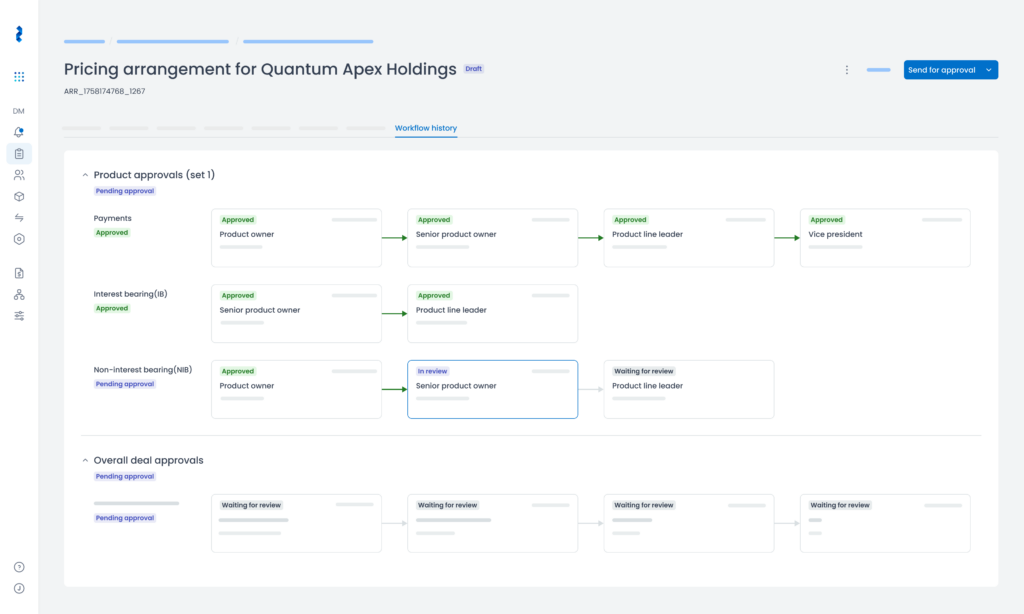
You spend your time selling, not following up.
Stage 4: Managing the Relationship
What your world looks like today:
Once the deal is live, it’s out of sight. You don’t know how clients are tracking until month-end. If commitments aren’t met or volume changes affect profitability, you find out after the statement’s gone out — when it’s too late to act.
What it should look like:
You have live visibility into your book of business. Balances, transactions, and earnings credits update throughout the month. If a client is trending off target, you know immediately.
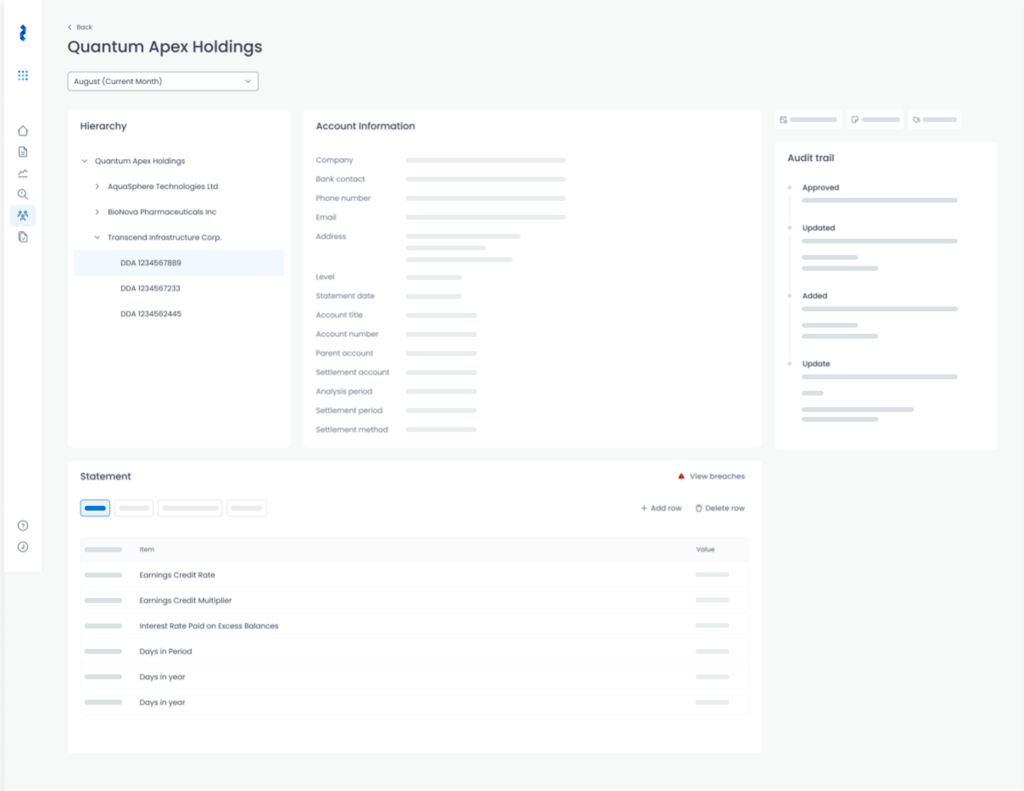
You can reach out early, adjust, and protect both your margin and the relationship.
Stage 5: Renewals and Reviews
What your world looks like today:
Deals live in folders and inboxes with no reminders or structure. Reviews happen reactively, often after pricing has gone stale.
One banker described it best:
Our waivers live forever.
What it should look like:
Every deal has a defined start, end, and review date. You get alerts before renewals lapse. The system flags clients due for repricing or those whose performance has changed.
You stay ahead of renewals instead of catching up to them.
Why It Hasn’t Changed — Yet
The problem isn’t effort or intent. It’s the foundation. The system everything sits on — Account Analysis — was never built for Sales. It was designed decades ago to calculate fees and produce statements. That’s all it was meant to do.
But that world doesn’t exist anymore. Clients expect transparency. You need speed. The bank needs control. And legacy systems can’t deliver all three.
As one banker put it,
We’re still doing things the way we did in the 1990s. Everything else in banking has gone real-time except this.
Henry Ford once said,
If I had asked people what they wanted, they would have said faster horses.
That’s what’s happened here — small fixes, add-ons, and spreadsheets trying to make an old process keep up.
It’s time to reimagine this process. We don’t need faster horses. We need something entirely new. We need a car.
Reimagined Account Analysis: Built for Treasury Sales
That’s exactly what Zafin has created with Reimagined Account Analysis — a complete reinvention of how Treasury Sales works, from pricing to renewal.
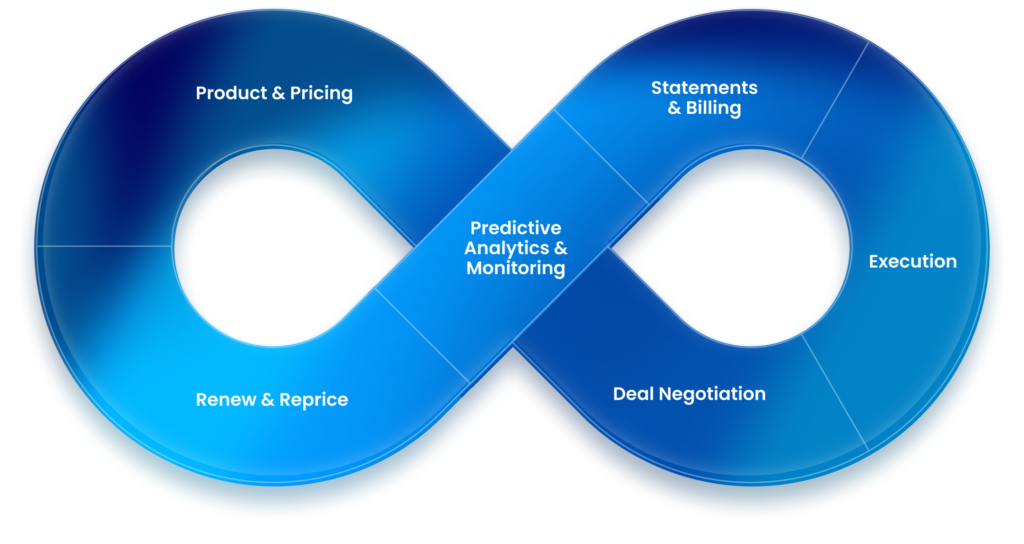
It brings together Zafin’s most powerful capabilities into one connected ecosystem designed around your workflow:
- Product Catalog gives you a single source of truth for standard pricing, guardrails, and rules. You always know what’s current and where you can flex.
- Deal Manager lets you configure and model deals in real time, adjusting rates, balances, and terms to instantly see the overall financial impact of the deal. Its new incentive view even shows how each deal contributes to your commissions, helping you make smarter, more rewarding decisions.
- Billing ensures that what you negotiate is what gets executed and billed, automatically and accurately.
- And at the center of it all, the Zafin Account Analysis Manager connects every piece together — providing live visibility into client performance, profitability, and commitments across the entire relationship.
With Reimagined Account Analysis, you finally get what you’ve been asking for: clarity before the deal, confidence during it, and transparency after.
The Future Starts With You
You already do the hard part — building trust, winning business, and defending value in every conversation. Now it’s time for your system to work as hard as you do.
Reimagined Account Analysis gives Treasury Sales teams the visibility, speed, and precision to sell with confidence and grow with purpose.
Because the future of Treasury Sales doesn’t start at month-end. It starts with you.